







Making mistakes at work is a normal part of learning. Nobody’s perfect, and even the most skilled and experienced professionals can make errors from time to time.
The key is not to avoid making mistakes altogether, but to learn from them and implement improvement strategies. This involves a process of editing and refining your work to achieve the best possible results.
By acknowledging and addressing work mistakes, you can turn errors into valuable learning experiences. This can help enhance your professional growth and productivity.
Understanding the Importance of Editing
Oscar Wilde once said,
“Experience is simply the name we give our mistakes.”
This quote shows how important it is to learn from our mistakes. Editing is more than just fixing errors. It’s about making our work better so it clearly says what we mean.
The Importance of Editing is huge. It makes our work better. By carefully checking and changing our content, we make it clearer and more powerful. This is key to creating work that is error-free and grabs people’s attention.
Editing is not just about fixing mistakes. It’s about making our work better. We check for grammar and spelling mistakes. We also make sure our content is easy to follow and understand. Good editing can really change how people see our work.
Also, editing lets us make our message stronger. We can make our content fit what our audience wants. This makes our work more effective.
In short, editing is very important. It’s a key part of writing that can greatly improve our work. By seeing editing as essential, we can create content that is polished, engaging, and impactful.
The Editing Checklist: What to Look For
To refine your work, it’s essential to have an editing checklist that covers all critical aspects.
An editing checklist is a writer’s best friend when it comes to reviewing and revising their work. It ensures that no detail is overlooked, from grammar and punctuation to spelling.
Grammar, Punctuation, and Spelling
One of the primary components of an editing checklist is checking for errors in grammar, punctuation, and spelling. These elements are fundamental to clear and effective communication in writing.
When reviewing your work, pay close attention to commonly confused words, verb tense consistency, and the correct use of commas and apostrophes.
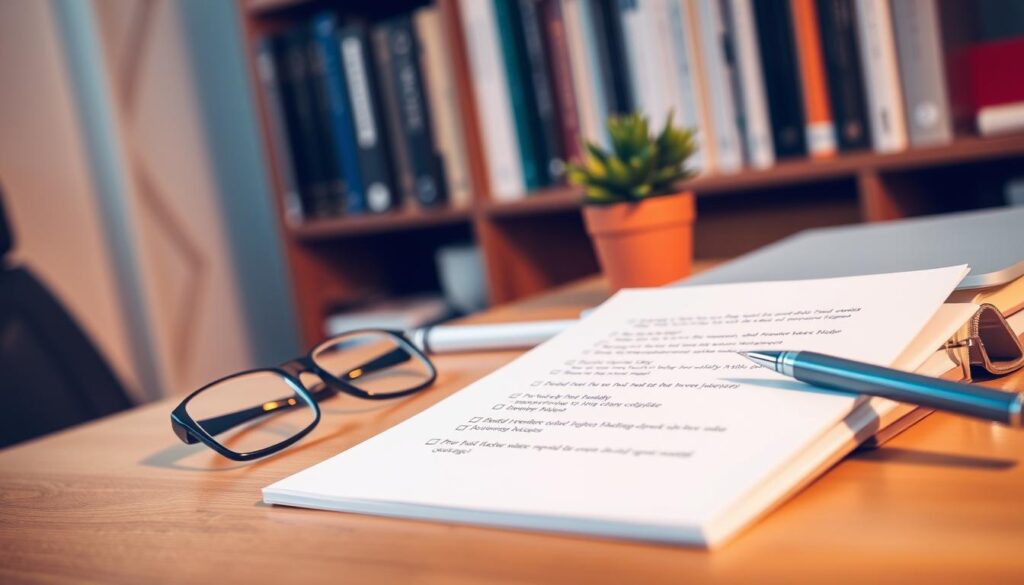
By meticulously going through your work with an editing checklist, you can significantly improve its quality and readability.
Different Types of Editing Explained
Editing is an art with many methods, each with its own purpose. Knowing these types of editing helps you improve your work to its best.
There are mainly three editing types: developmental editing, line editing, and proofreading. Developmental editing looks at the work’s structure and content. It makes sure the story flows well and arguments are strong.
Line editing checks the text’s details, like sentence structure and tone. It aims to make the writing clear and engaging. This stage is key for delivering the message well.
Proofreading is the last step, focusing on grammar, punctuation, and spelling. It’s all about making the text perfect and error-free.
There are also other editing techniques, like copy editing. It mixes line editing and proofreading to ensure the text is consistent and accurate.
By using these types of editing and editing techniques, writers can greatly enhance their work. This makes it more coherent, engaging, and professional.
Effective Self-Editing Techniques
Learning to self-edit is vital for creating top-notch content. It helps writers make their work shine by fixing errors and making it more engaging.
One great way to self-edit is to take a break from your writing. Taking a few hours or days off can give you a fresh perspective. This makes it easier to spot what needs work.
Being objective is another key technique. Imagine reading your work as if you were the audience. Look for clarity, coherence, and flow. Grammar and spell checkers can also help catch mistakes you might miss.
Getting feedback from others is also super helpful. Sharing your work with peers or mentors can bring new ideas and suggestions. Good feedback can point out areas for improvement, helping you make your work even better.
Lastly, be thorough and patient when self-editing. Hurrying through can lead to missed errors and a lower quality result. By taking your time, you can greatly improve your work’s quality and impact.
The Benefits of Professional Editing Services
Henry Ford once said,
“The only real mistake is the one from which we learn nothing.”
This quote highlights the importance of learning from mistakes. Professional editing plays a big role in this. It helps writers improve their work by pointing out and fixing errors.
Professional editing services bring many benefits. They make writing clearer, more coherent, and free of grammar mistakes. Editors check the text to make sure the message gets across well. They make changes to make the content easier to read.
The work enhancement from professional editing is huge. It makes sure the writing is polished and without mistakes. This is key in school and work, where good writing shows a writer’s skill.
In short, professional editing services have many benefits. They help writers improve, learn from mistakes, and create top-notch writing. For personal or professional growth, getting professional editing is a smart move.
Understanding Your Audience During Editing
To edit well, you need to know what your audience wants and likes. Audience awareness is key to making your content hit the mark. It makes sure it’s both relevant and fun to read.
Think about your audience’s age, job, and hobbies when editing. For example, technical stuff for pros should sound formal. But a blog for teens might be more laid-back. Knowing these details helps you make better choices while editing.
“The art of writing is applying the seat of the pants to the seat of the chair.” – Mary Heaton Vorse. This quote shows how important dedication and knowing your audience are in writing and editing.
While editing, ask yourself: “Does this content speak to my audience?” or “Is the language easy for them to understand?” Making these adjustments boosts your content’s impact.

Knowing your audience’s needs also lets you tailor your message better. This makes your content more relatable and fun. This knowledge is the heart of good editing, making sure your work is both useful and enjoyable for your audience.
Collaborating with Peers for Editing
Working with peers can give you a fresh view on your work. It helps you spot areas you might have overlooked. This teamwork, known as peer review, is key to making your work top-notch.
Peer review lets you see your work from someone else’s perspective. It’s great for finding what needs work and for improving your editing skills. You also get to give editing feedback to others.
Set clear goals and expectations for working together. Decide what feedback you want and what you aim to achieve.
Be ready for constructive criticism. Feedback can be tough, but it’s a chance to grow and get better.
Use the feedback to make specific changes. This will improve your work and fix any issues found during peer review.
By joining forces and using peer review, you can make your work better. It will be more engaging and effective for your audience.
Timing Your Editing Process
The timing of your editing process is key to quality work. Good time management helps you see your work with fresh eyes. This leads to better revisions.
It’s smart to take breaks between writing and editing. This clears your mind and lets you see your work more clearly. Setting up editing sessions also boosts your productivity. It keeps you focused and stops burnout.

Adding regular breaks and structured editing times to your workflow improves quality. It helps spot errors and makes editing more efficient.
For the best editing time, try a time-blocking schedule. This means setting aside specific times for editing, then taking short breaks. It keeps your focus sharp and stops you from getting tired.
In short, how you time your editing is very important for quality results. Using good time management and a careful editing schedule boosts your productivity. This makes your editing more effective.
Revisions: Making the Most Out of Feedback
Feedback is key to making your work better. It gives you insights that can boost your quality. When you get feedback, it’s important to keep an open mind. This way, you understand it’s meant to help improve your work.
To make revisions, you first need to review the feedback carefully. Look for both big and small suggestions. It’s important to know which feedback is truly helpful and which might not be as important.
After analyzing the feedback, you should use the good suggestions to improve your work. This might mean rewriting parts, changing how things are organized, or even starting over. The aim is to make your work better.
Effective revision is not just about making changes; it’s about making the right changes. It’s about understanding the feedback, seeing if it’s valid, and using it to strengthen your work. This takes patience and a willingness to learn and change.
Using feedback well can really improve your work’s quality. By seeing feedback as a tool for growth, you can create work that’s not just polished but also powerful. Remember, the goal of revisions is to make your work the best it can be.
Common Editing Mistakes to Avoid
To make sure your work is perfect, you need to know and avoid common editing mistakes. Editing is key to making your writing shine. Neglecting to proofread is a big mistake. A good proofread can spot errors that hurt your credibility.
Another big mistake is failing to consider your audience. Knowing who you’re writing for is essential. You should use language they can understand and make sure your message is clear. Ignoring the tone and style of your writing can mess up the flow.
Overlooking consistency in formatting and style is another error. Being consistent makes your work easier to read and looks more professional. Also, not taking breaks between writing and editing can cause you to miss things. A fresh look is important for catching mistakes.
Knowing these common mistakes helps you avoid them. This way, your work will be top-notch. Good editing is not just about fixing errors. It’s also about making your writing flow better and clearer.
Tools and Resources for Successful Editing
Technology has made many editing tools and resources available. These tools help with grammar, punctuation, and style. They make editing easier and more efficient.
Grammar checkers are a big help for editors. Tools like Grammarly and Ginger check grammar, punctuation, and spelling. Style guides like the Chicago Manual of Style and the AP Stylebook offer detailed rules on formatting and writing.
Technology has introduced many editing software and apps. The Hemingway Editor makes sentences clearer and easier to read. Google Docs allows for real-time feedback and editing.
Online dictionaries and thesauruses help pick the right words and avoid repetition. Guides and tutorials online share tips on editing and best practices.
Using these editing tools and resources can greatly improve your work. Whether you’re a professional writer or just want to improve your writing, these tools can help a lot.
The Final Touch: Polishing Your Work
After editing, it’s key to do final checks to make sure your work is perfect. This step is important to ensure your work is complete and top-notch.
Reviewing your work carefully means checking if everything is there and if it makes sense. It’s also important to look for grammar, punctuation, and spelling mistakes. These errors can lower the quality of your work.
Spending time on this final step helps make your work the best it can be. It’s about paying attention to every detail and striving for excellence.
Finishing your work is not just about completing it. It’s about delivering a product that is of high quality. By adding final checks and polishing, you can make your work professional-grade.