







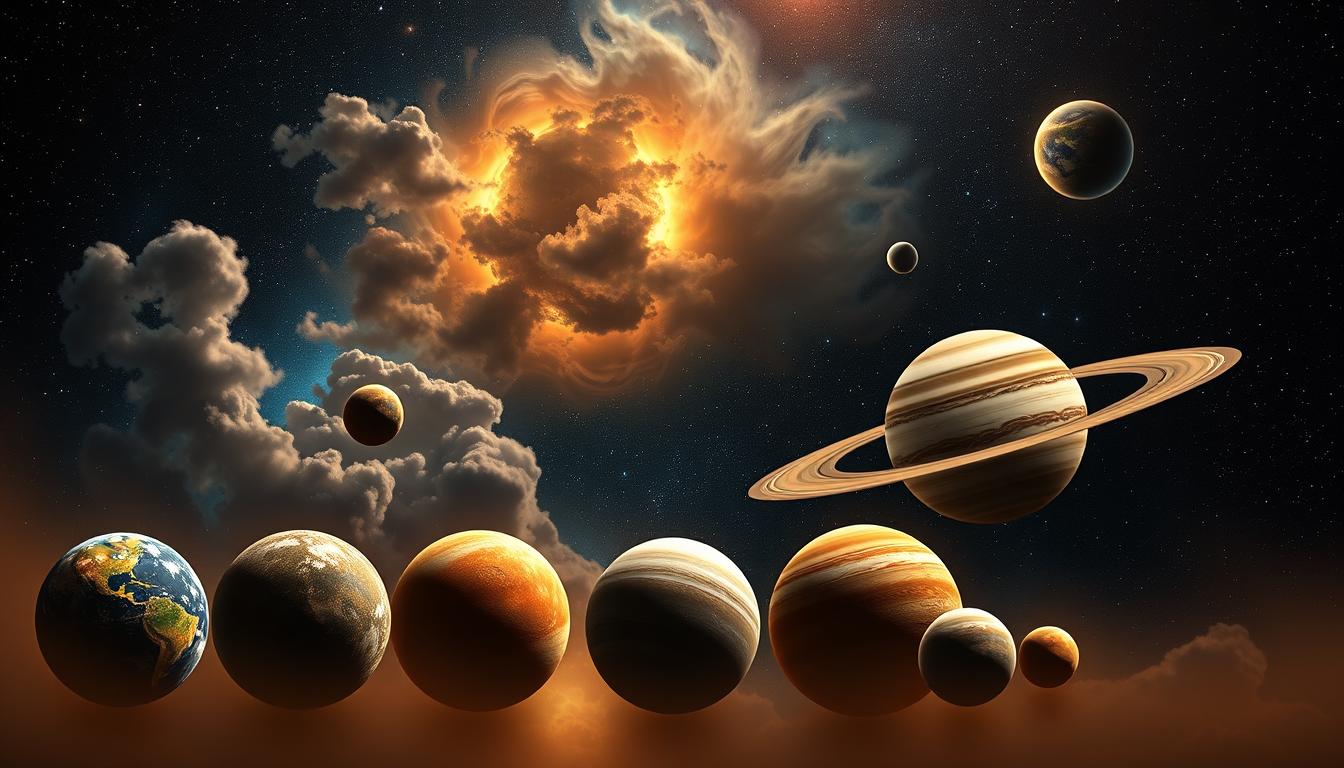
Start a journey through the Solar System and learn about the amazing celestial bodies in it. The word “planet” comes from ancient Greek, meaning “wanderer.” This fits well with how these bodies move around the Sun.
Our Solar System has eight planets, each with its own Planetary Features. Mercury has rocky ground, while Jupiter is a huge gas ball. This shows how different the planets are from each other.
Learning about these planets helps us understand the universe better. It also shows how special Earth is. Let’s dive into the wonders of the planets and why they matter to us.
What is a Planet?
In 2006, the International Astronomical Union (IAU) gave a clear answer to the planet question. This definition was key in showing what makes planets different from other space objects in our Solar System.
The IAU said a planet must: (1) orbit the Sun, (2) be nearly round in shape, and (3) clear its orbit area. This led to Pluto being called a dwarf planet, a new type of object.
Pluto’s change was big in Astronomy. It changed how we see our Solar System. Now, we know planets and other space bodies are different.
Knowing what a Planet is helps us understand our Solar System better. It shows how planets are special and play important roles in Astronomy.
The Solar System Overview
Understanding the solar system’s structure is key to learning about astronomy. It’s a vast and complex system. It has many planets and celestial bodies that work together.
The solar system is split into two main parts: the inner and outer solar system. The inner system has four planets: Mercury, Venus, Earth, and Mars. These planets are close to the Sun and are smaller than the outer planets.
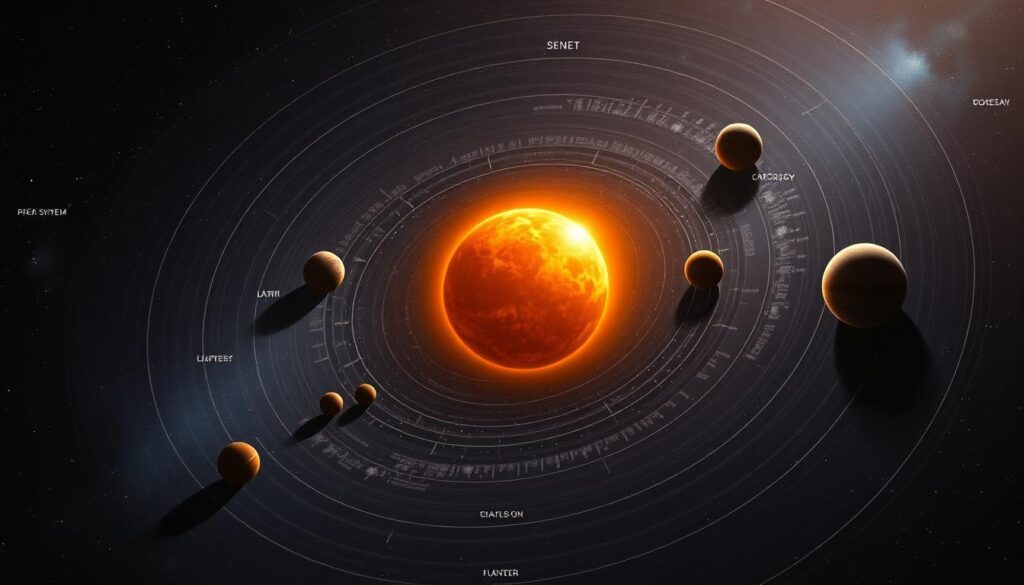
The outer solar system includes Jupiter, Saturn, Uranus, and Neptune. These are gas giants, with Jupiter being the biggest. The outer planets are huge and have many moons and rings.
Studying the solar system’s structure helps us learn about its formation and evolution. By looking at the differences between the inner and outer solar system, astronomers can understand the solar system’s planetary structure better.
The Inner Planets
The terrestrial planets, including Mercury, Venus, Earth, and Mars, give us clues about our solar system’s start. These planets have solid surfaces and are close to the Sun. They are called inner planets.
Terrestrial Planets
The inner planets are like Earth in many ways. They have solid surfaces. Mercury is the closest to the Sun. It has a very oval-shaped orbit, leading to huge temperature swings.
Venus is the hottest planet because of its thick atmosphere. This atmosphere traps heat. Yet, Venus rotates very slowly and in the opposite direction of its orbit.
Earth is the only planet we know of that supports life. It has many different ecosystems and a perfect atmosphere for life. Mars, known as the Red Planet, is thought to have once had water. It’s a place that might have life and has geological features that show water once flowed.
Studying these terrestrial planets helps us understand our solar system’s history and evolution. By looking at Mercury, Venus, Earth, and Mars, scientists learn what makes a planet good for life.
The Outer Planets
Beyond the inner planets, we find gas giants and ice giants. These are the outer planets. Our solar system’s outer planets are Jupiter, Saturn, Uranus, and Neptune. They are mostly made of gases and ices.
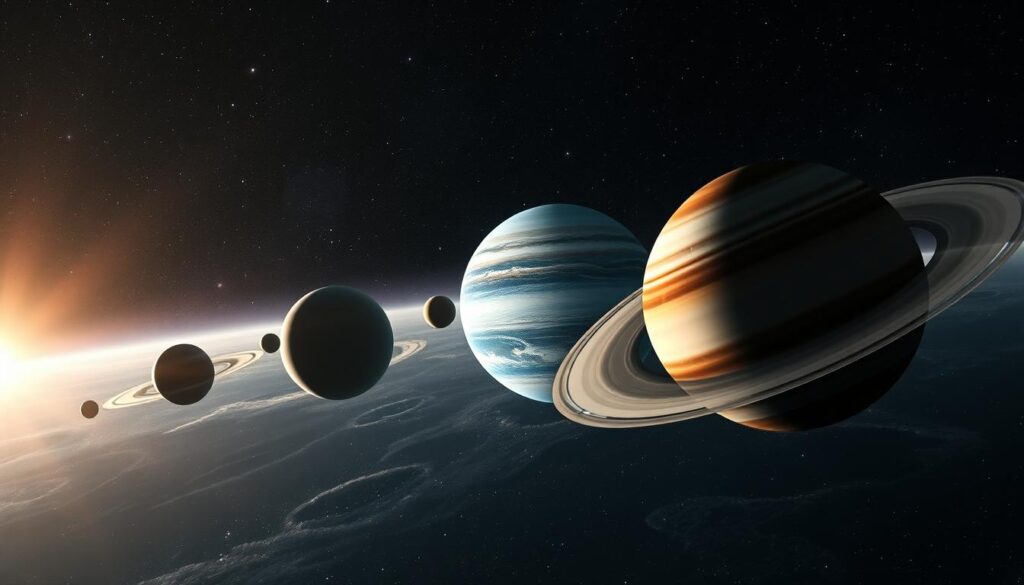
The gas giants, Jupiter and Saturn, are huge and have atmospheres full of hydrogen and helium. Jupiter is the biggest planet and has a famous storm called the Great Red Spot. Saturn is known for its beautiful ring system, made of ice and rock.
The ice giants, Uranus and Neptune, have more ices like water, ammonia, and methane. They look blue because of methane in their atmospheres. Uranus has a tilted axis that causes extreme seasons. Neptune is famous for its strong winds and weather.
Studying the outer planets gives us clues about our solar system’s creation and growth. By looking at these planets, scientists learn about the early days of our cosmic neighborhood.
Exoplanets: Worlds Beyond Our Solar System
The search for exoplanets is changing how we see the universe and the chance of life elsewhere. Exoplanets are planets that orbit stars other than our Sun. They give us clues about life beyond Earth.
Methods of Detecting Exoplanets
Astronomers have a few ways to find exoplanets. One method is when a planet passes in front of its star. Another is by measuring the star’s wobble caused by a planet’s orbit.
The Significance of Exoplanet Discoveries
Exoplanet discoveries are big for understanding planets and searching for life. With thousands found, scientists can study different planets and their life-supporting abilities.
Studying exoplanets is growing our universe knowledge and making us wonder about Earth’s uniqueness. As research goes on, finding exoplanets will keep being exciting in astronomy.
The Formation of Planets
The study of planetary formation is fascinating in astronomy. It shows how gas and dust in the early solar system turned into planets. This process is complex but essential to understanding our world.
Planets start forming from a giant cloud of gas and dust, called a nebula. As it collapses, it spins faster and flattens into a disk around a central star. Particles in this disk collide and grow, becoming planetesimals, the first steps towards planets.
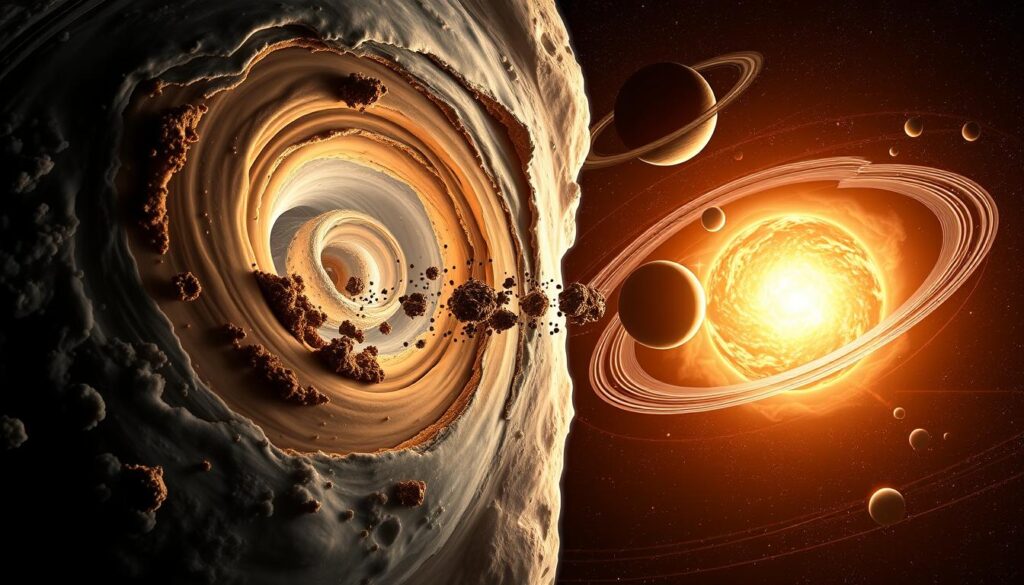
These planetesimals keep growing by colliding with each other. Eventually, they form the planets we see in our solar system today. Studying planetary formation helps us understand our solar system’s history. It also gives clues about life on other planets in astronomy.
Learning about planetary formation is key to understanding our solar system‘s history. It helps scientists grasp the complex interactions that have shaped our cosmic neighborhood.
The Role of Gravity
Gravity plays a key role in the solar system, affecting planetary orbits and stability. It’s a fundamental force that guides the motion and interactions of celestial bodies.
According to
“Gravity is the force that holds the universe together, from the smallest asteroid to the largest galaxy.”
Gravity’s influence on planetary motion is clear in how planets orbit the Sun. The Sun’s gravitational pull keeps planets in their orbits, stopping them from flying off into space.
The stability of our solar system comes from gravity too. Planets’ gravitational pull on each other keeps their orbits stable and prevents big crashes.
In astronomy, knowing about gravity is key to understanding how planets move. By studying gravity, astronomers learn about the solar system’s formation and growth.
Unique Planetary Features
Planets have unique features that tell us about their beginnings and growth. Each one in our solar system has its own special traits. These have amazed astronomers and scientists for a long time.
Earth is special because it has many different ecosystems and a life-supporting atmosphere. It has liquid water and a stable climate, perfect for life. On the other hand, Jupiter’s Great Red Spot is a huge storm that has lasted for centuries. It’s so big, it could swallow several Earths, showing Jupiter’s enormous size.

Other planets also have unique features. Saturn’s ring system is a breathtaking sight, made of ice particles and rock debris. The rings are very thin, just 30 feet thick in some spots, but stretch for hundreds of thousands of miles. Venus’s thick atmosphere, mostly carbon dioxide, makes it the hottest planet due to a strong greenhouse effect.
Studying these planetary characteristics is key for astronomers. They learn about our solar system’s history and growth by looking at each planet’s unique traits. This helps scientists understand how our neighborhood came to be.
In the field of Astronomy, studying planetary features is a thrilling area of research. New discoveries keep revealing the universe’s secrets.
The Search for Life on Other Planets
Astrobiologists are on a mission to find life on other planets. They are exploring the cosmos and pushing our understanding of it. They look for life on exoplanets and moons in our solar system.
The idea of life beyond Earth is fascinating. Scientists use many methods to find signs of life. They study the atmospheres of exoplanets for gases that living things might make.
The discovery of exoplanets has changed how we see the universe. Some of these planets might be able to support life. They are in the habitable zones of their stars.
Astrobiology is leading this research. It combines biology, chemistry, and astronomy. By studying Earth’s extreme life forms, scientists learn about possible life on other planets.
Discovering life on other planets would change everything. It would show that life isn’t just on Earth. It could also tell us about the origins of life and if there’s intelligent life out there.
Conclusion: The Importance of Understanding Planets
Understanding planets is key to learning about our Solar System’s creation and growth. By looking into planets, we see their role in the universe. This helps us appreciate their importance and their place in the cosmos.
The study of planets shows us how diverse and complex they are. It helps us understand how they change over time. Exploring the Solar System and beyond teaches us about our place in the universe.
Studying planets helps us learn more about the universe and its wonders. As Astronomy research grows, we might find new things about our Solar System’s planets. We could also learn about other planetary systems out there.