







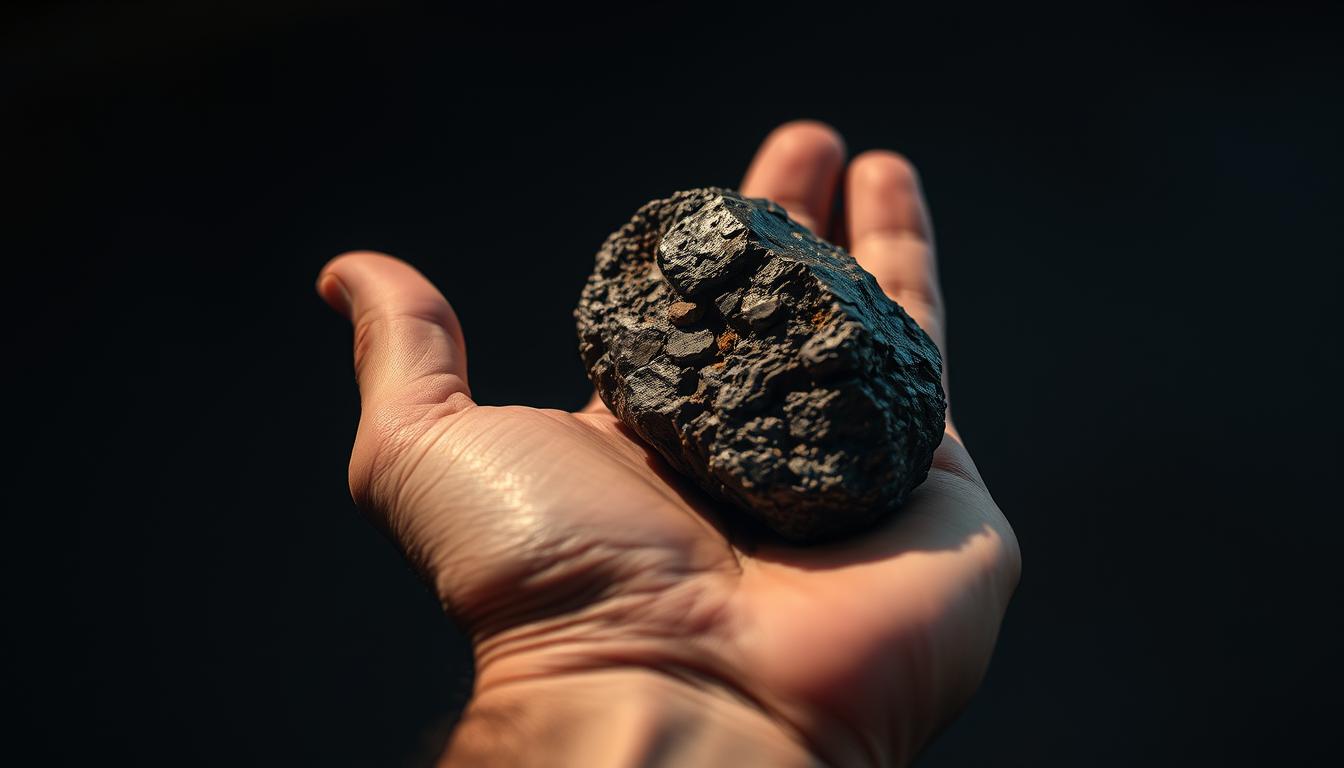
Imagine holding a piece of space rock in your hands. It’s a fragment that has traveled millions of miles through the cosmos. Holding a real meteorite is a unique experience. It connects you to the vastness of the universe.
Meteorites are remnants of asteroids, planets, and other celestial bodies. They are preserved for millions of years. When a meteorite falls to Earth, it provides a tangible link to the cosmos. This makes it fascinating for scientists and collectors alike.
Many people find unusual rocks or pieces of metal. They wonder if they might have stumbled upon a meteorite. Exploring the world of meteorites and their characteristics is thrilling. It uncovers meteorite facts that reveal the mysteries of the universe.
What Is a Meteorite?
A meteorite is a piece of rock or metal from outer space. It comes from asteroids or other celestial bodies. These pieces are pulled towards Earth by gravity.
When they enter Earth’s atmosphere, they face intense heat and friction. This creates a fusion crust on their surface. This crust makes meteorites different from Earth rocks.
Meteorites fall into three main types: stony, iron, and stony-iron. Stony meteorites are mostly rock. Iron meteorites are metal. Stony-iron meteorites have both.
Knowing about meteorite definition and characteristics helps scientists identify them. By studying their composition, density, and magnetism, scientists learn about their origins. This knowledge also tells us about our solar system’s history.
The History of Meteorites
The story of meteorites is as old as humanity’s observation of the night sky. Ancient civilizations saw meteorite falls. They often saw them as omens or signs from the gods.
Ancient Cultures and Meteorites
Some ancient cultures saw meteorites as sacred objects. They used them in rituals and ceremonies. Meteorites were not just spiritual; they were also seen as mysterious objects from the sky.
As science grew, so did our understanding of meteorites. The first scientific descriptions of meteorites came in the 18th century. This marked a shift from superstition to science. Today, studying meteorites helps us understand our solar system.
Significant Meteorite Falls
History has many documented meteorite falls. Some have become key parts of ancient cultures’ stories. These events sparked public interest and scientific study of meteorites.
The history of meteorites is filled with science, culture, and curiosity. By studying meteorites, we learn more about the universe and our place in it.
How Meteorites Reach Earth
Meteorites travel through space, pulled by gravity, until they hit Earth’s atmosphere. This path is both complex and dynamic, filled with celestial interactions.
When meteorites enter Earth’s atmosphere, they face intense heat and friction. This can make them glow brightly, creating a meteor or shooting star. “Meteorites: A Petrologic, Chemical, and Isotopic Synthesis” by Harry Y. McSween Jr. and Gary R. Huss explains, “Most meteorites that land on Earth come from asteroids.”
“The fall of a meteorite is a spectacular event, often producing a bright trail in the sky that can be seen for miles.”
If a meteorite makes it through the heat of entry and lands, it’s called a meteorite fall. Its path is shaped by its size, shape, and composition, plus the gravity it meets.
Studying meteorite falls and their paths helps scientists understand these space rocks. By tracking a meteorite’s path, scientists learn about its meteorite’s history and the forces that shaped it.
In conclusion, meteorites’ journey to Earth is complex. It involves gravity, atmospheric entry, and the chance for meteorite falls. Knowing this helps us appreciate meteorites’ role in our solar system.
The Science Behind Meteorites
Meteorites are a complex and fascinating subject. They help us understand the solar system. Their composition and classification are key to this understanding.
Meteorites are made of minerals like olivine, pyroxene, and plagioclase. They also contain metals like iron and nickel. The mix of these elements tells us about where they came from.
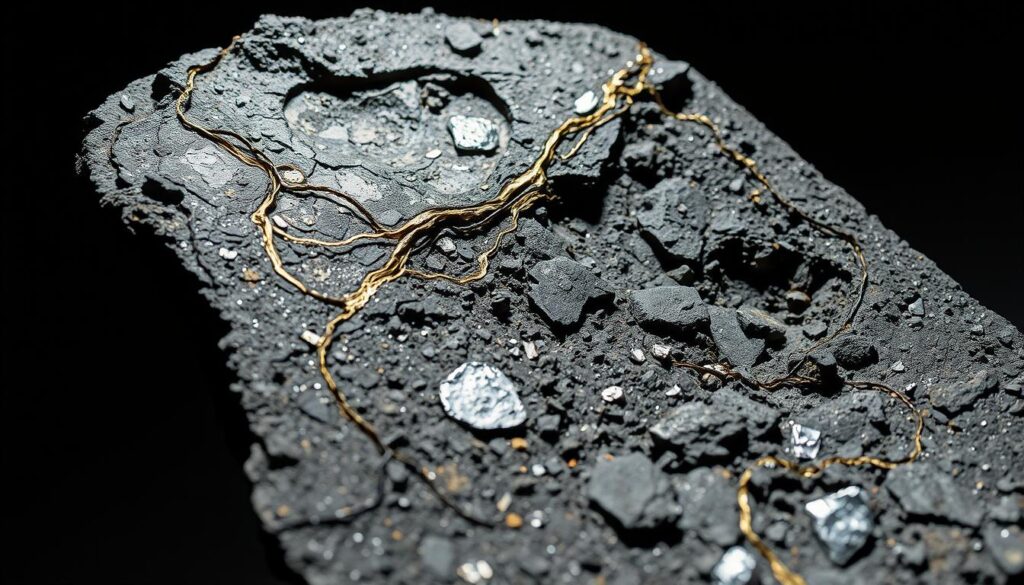
Meteorites are grouped into types based on their makeup. There are ordinary chondrites, carbonaceous chondrites, and achondrites. Ordinary chondrites have small particles called chondrules. Carbonaceous chondrites are rich in carbon and water, important for early solar system studies. Achondrites have melted and changed, like some Earth rocks.
Studying meteorites gives us a peek into their own history and the solar system’s past. By looking at their composition and types, scientists can piece together the solar system’s early days.
Myths and Misunderstandings
Meteorites have always fascinated people, but they’re filled with myths and misconceptions. Many think meteorites are always hot when they hit Earth. Others believe they’re always made of metal. But the truth is far from it.
Most meteorites are actually cold when found. They cool down in space because there’s no heat transfer. This means they’re not hot when they land. Many even have frost on them because they cool down fast after entering Earth’s atmosphere.
Meteorites come in many types. While some are metallic, others are stony or stony-iron. The stony ones can look like regular rocks, making them hard to spot as meteorites. This variety leads to many misconceptions about them.
It’s important to clear up these myths to truly understand meteorites. By learning about their real nature and origins, we see them as valuable pieces of our solar system’s history. Meteorites give us insights into how celestial bodies form and change. They’re important for scientists, collectors, and enthusiasts alike.
The mystery of meteorites is part of their charm. As we learn more about them, we also debunk common myths. This deepens our respect for these incredible objects.
Meteorite Collecting as a Hobby
Meteorite hunting is a mix of adventure, science, and the thrill of the unknown. It’s a hobby that combines exploration, science, and the chance to find something extraordinary.
Meteorite collectors use metal detectors and their eyes to find meteorites in different places. It’s not just about finding a meteorite. It’s about the journey, learning, and the community that comes with it.

Meteorite collecting is a favorite hobby for many. They search for meteorites all over the world. These collectors are passionate about understanding our solar system’s origins and the universe’s history.
For meteorite collectors, the search is a journey of discovery. It involves research, exploration, and sometimes luck. The excitement of finding a rare meteorite is a big part of the hobby’s charm.
The meteorite hunters community is varied. It includes both amateur and professional collectors. They share a love for meteorites and often work together, share information, and support each other.
Meteorite collecting connects us to space and the scientific and historical value of meteorites. It encourages learning, exploration, and a deeper appreciation for the universe’s mysteries.
Authenticating a Meteorite
Meteorite authentication is a detailed process. It includes density measurements, magnetic tests, and microscopic examinations. These steps are vital to confirm a meteorite’s identity and scientific worth.
The first step is to measure the meteorite’s density. Meteorites usually have a higher density than Earth rocks because of their iron content. By comparing the meteorite’s weight in air and water, experts can figure out its density.
Another important test is checking for magnetism. Many meteorites are drawn to magnets because they contain iron. But, not all meteorites are magnetic, so this test is used alongside others.
A microscopic examination is also key. This involves cutting and polishing a sample to look at its internal structure. Meteorites often have unique features like chondrules or a fusion crust that can be seen under a microscope.
Experts use these tests to tell meteorites apart from Earth rocks and classify them. For those who think they’ve found a meteorite, meteorite testing and meteorite verification are essential to prove it.
By using these thorough testing methods, meteorite fans and scientists can confirm their finds. This helps us understand meteorites better and their importance.
Caring for Your Meteorite
Caring for your meteorite is key to keeping it for the future. After it’s confirmed, its care is very important.
Meteorites are sensitive to moisture, temperature, and light. These can make them wear down. Proper storage, handling, and display are vital for keeping them safe.
Keeping your meteorite in a stable environment is essential. This means keeping the temperature and humidity steady. Avoid extreme temperatures or sudden humidity changes to prevent damage.
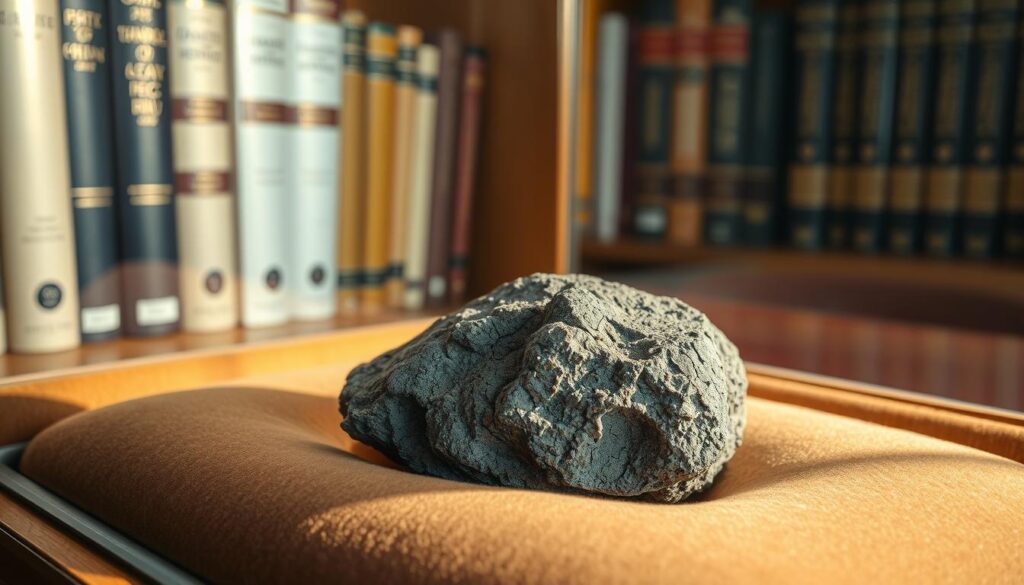
Choosing the right materials for storage and display is also critical. Use acid-free and archival-quality materials to avoid harm. Stay away from plastics or metals that might react with the meteorite.
Handling your meteorite as little as possible is important. When you must handle it, use gloves to prevent oils from your skin from touching it. This helps keep the surface intact.
Displaying your meteorite correctly is also key. Use a display case that keeps the environment stable and protects from light. Consider using UV-filtering glass or acrylic to reduce light effects.
By following these steps, you can keep your meteorite in great shape for years. Proper care and preservation are essential for its scientific value and integrity.
The Value of Meteorites
Meteorites have many values, including scientific, economic, and cultural. They give us a peek into the early solar system and how planets formed. This makes them very important for science.
From a scientific view, meteorites tell us about the solar system’s early days. They are pieces from the past, showing us how our universe evolved. The meteorite value comes from their role in studying the past of our cosmos.
Some meteorites are also valuable because of their rare minerals and metals. These meteorites contain materials not found on Earth, making them worth money. The meteorite worth depends on how rare they are, what they’re made of, and their condition.
Meteorites also hold a special place in human culture. They inspire wonder and are sometimes seen as sacred. They connect us to the universe, showing the bond between Earth and space. The meteorite significance goes beyond science, touching our hearts and minds.
In summary, meteorites are complex, with values in science, economy, and culture. Learning about their meteorite value and importance helps us understand our solar system’s history and their cultural significance.
Meteorite Museums and Exhibitions
Museums play a key role in teaching people about meteorites. They show meteorites from all over the world. These museums have a wide variety of meteorites that have landed on Earth.
Visiting meteorite exhibitions is a great way to learn. You can see everything from rare iron meteorites to stony ones with special features. Meteorite museums tell you all about each meteorite. They share its origin, what it’s made of, and how it fell to Earth.
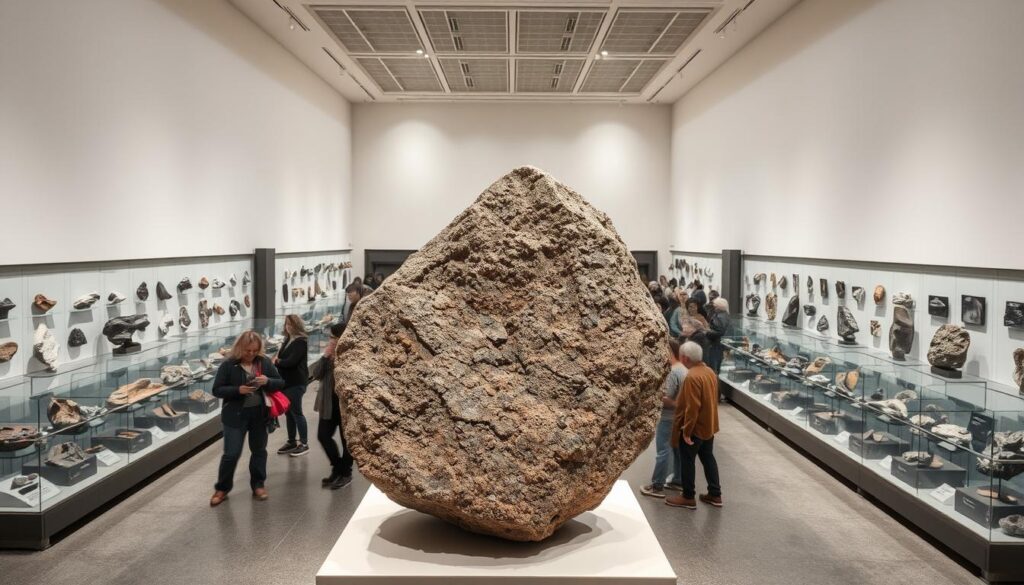
Meteorite exhibitions also inspire the next generation of scientists. They make meteorites accessible to everyone. This helps people understand the universe better.
The role of meteorite displays goes beyond teaching. They help keep meteorites safe for study and enjoyment. Museums preserve these important scientific treasures for us all.
Future of Meteorite Research
The study of meteorites is growing, thanks to new technology and our endless curiosity about space. We’re learning more about our solar system’s past and where life might have started.
Scientists are using new methods to study meteorites. This will help us understand how our solar system formed and how planets came to be. The future of meteorite studies is full of exciting discoveries that will amaze scientists and the public alike.
As we make new finds, we’ll learn more about the universe. We’ll uncover secrets about ancient asteroids and maybe even find signs of life from other planets. Studying meteorites reminds us of the universe’s vastness and the mysteries waiting to be solved.