





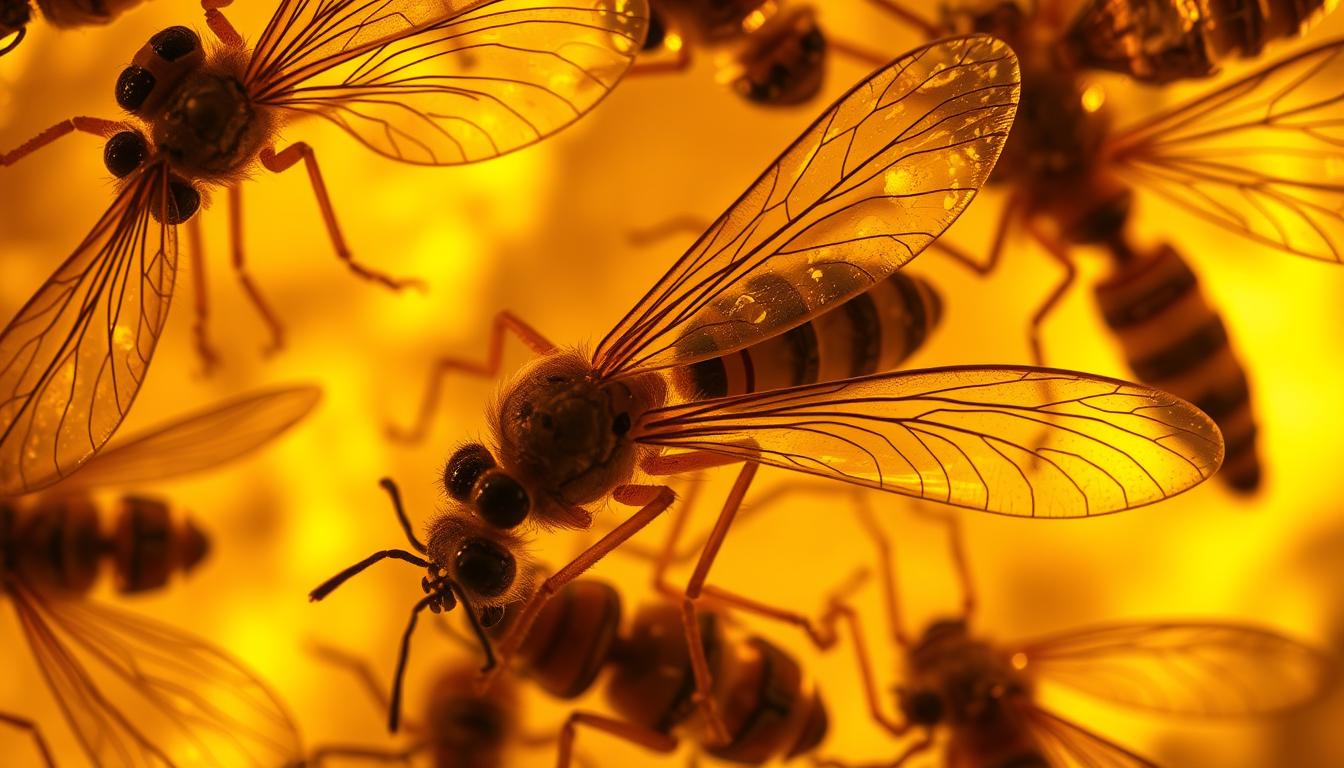
The world of insects in amber is truly captivating. It draws in scientists and the public alike. For ages, amber has been valued for its beauty and its role in preserving ancient life forms.
The preservation process in fossilized resin is amazing. It lets us study ancient insects in great detail. This natural preservation offers a peek into the past, showing us the life forms, behaviors, and evolution of these creatures.
By examining insects in amber, scientists learn a lot about Earth’s history. This knowledge helps us understand the rich diversity of life on our planet.
The Mesmerizing World of Fossilized Resin
The world of fossilized resin is truly captivating. It fascinates scientists and enthusiasts. Fossilized resin, or amber, is more than a gemstone. It’s a window into the past, showing us ancient life with amazing detail.
What makes amber special is its chemical makeup. It includes terpenes. These compounds are key in preserving life trapped in the resin.
Terpenes and Their Preservation Properties
Terpenes are organic compounds found in plants. They help plants fight off diseases and pests. In amber, terpenes help keep trapped organisms safe by stopping bacteria and fungi from growing.
The chemical composition of amber is complex. It has many compounds that work together to preserve life. This makes amber a treasure trove for scientists studying Earth’s history.
The Science of Amber: From Tree Resin to Gemstone
The story of how amber forms is quite complex. It involves chemical reactions, pressure, and time. Tree resin, made by ancient trees, is the start of amber. When this resin is buried, it changes a lot.
The resin first faces heat and pressure. This makes it go through polymerization. This means its molecules link together, making it stronger. After millions of years, this strong compound turns into amber, a gemstone loved for its beauty and history.
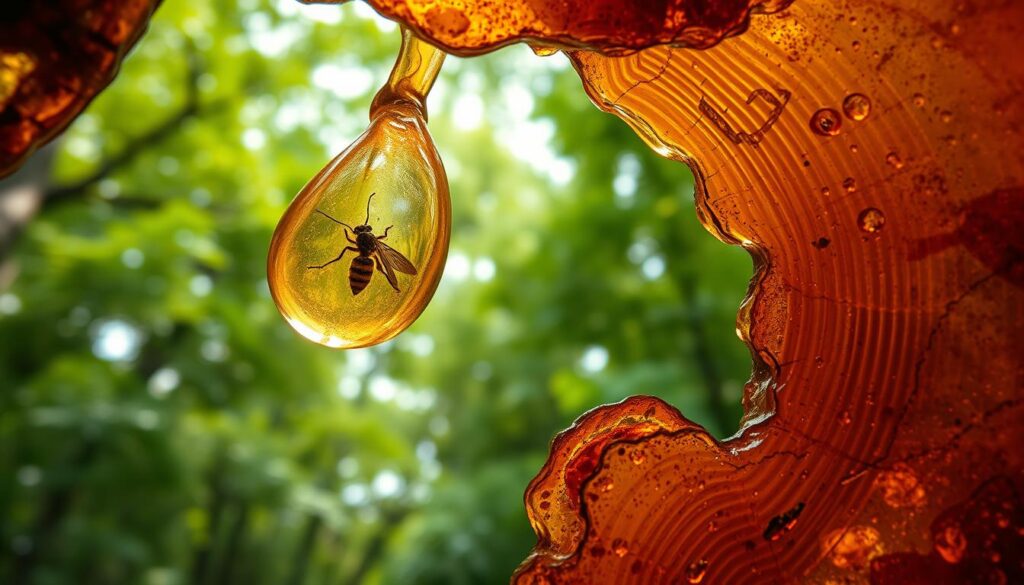
The amber formation process is shaped by many things. These include the resin’s makeup, where it was buried, and the geological events it saw. Because of this, amber can have many things trapped inside, like plant material and insects. This gives us a peek into the past.
Learning about the science of amber is not just interesting. It’s also key to seeing its worth in jewelry and science. Studying amber and its contents has helped us understand ancient worlds and how life evolved.
In short, the journey of tree resin to gemstone shows the amazing and complex ways our world is shaped. As we learn more about amber, we grow to love its rich history and beauty even more.
A Brief History of Amber Discoveries
For centuries, amber has fascinated people, showing us the ancient world. Its history is filled with ancient civilizations’ love for it. The Greeks and Romans valued amber for its beauty and mystical powers.
Significant amber discoveries have been found worldwide, from the Baltic to the Dominican Republic. These finds have given us a deep look into Earth’s history, like how plants and animals evolved. Amber’s ability to keep ancient life forms alive is truly amazing.
Today, scientists are making new amber discoveries that reveal Earth’s past. The history of amber shows its lasting charm. It’s a story of wonder and discovery.
The Moment of Discovery: Finding an Insect in Amber
Finding an insect in amber is a rare thrill for scientists and collectors. It takes patience, skill, and a bit of luck. The discovery process is as exciting as the find itself, with careful searching and extraction.
“I’ve spent decades collecting amber,” says Dr. Jane Smith, a renowned paleoentomologist. “But nothing compares to the excitement of finding a perfectly preserved insect.” Such collector’s stories are not just thrilling anecdotes; they are also valuable scientific contributions.
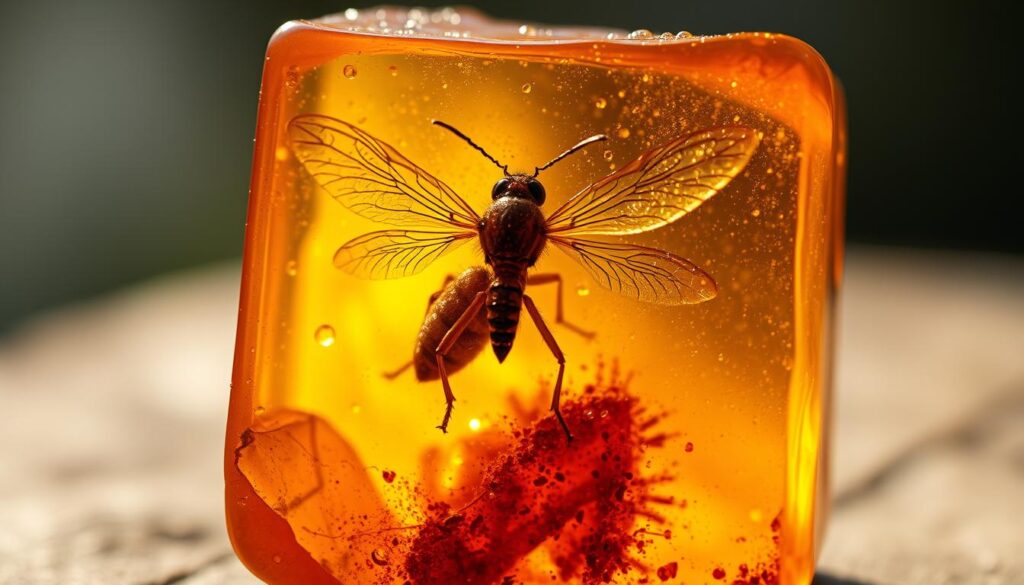
Finding insects in amber requires a deep understanding of the gemstone and its formation. Amber, a fossilized tree resin, can contain a variety of inclusions, from small insects to plant material. The process of discovering these inclusions involves carefully examining amber pieces, often using specialized equipment like microscopes.
“The moment I saw the insect’s wings, I knew it was a significant find,” recalls a seasoned collector. “It was a previously unknown species, providing a unique insight into the evolutionary history of that group.”
The challenges of working with amber and its inclusions are numerous, from the fragility of the material to the difficulty of dating the specimens. But the rewards are substantial, giving a window into the past that is unparalleled in the scientific world.
The Remarkable Preservation Process in Amber
Amber’s power to keep ancient life forms is amazing. It traps organisms in tree resin, which turns into amber over millions of years. This natural change creates a shield that protects the organisms, keeping their details intact.
The preservation process in amber is so good. It keeps the structure of ancient insects at the cellular level. This is rare in other fossilization methods, making amber special for scientists studying ancient life.
Cellular and Tissue Preservation
Amber’s ability to preserve cellular and tissue structures is incredible. The quick trapping of organisms in resin, followed by slow amber formation, helps preserve tiny details. This lets researchers do microscopic analysis of ancient insects, giving insights into their lives.
Studying ancient insects in amber has greatly helped us understand evolution and ancient ecosystems. By looking at the tissue preservation and cellular preservation in these specimens, scientists can accurately recreate the lives of ancient organisms.
In conclusion, the preservation process in amber is complex and very effective. It has kept ancient life forms in great detail. The study of these preserved organisms is fascinating, giving us a peek into the past.
Common Types of Insects Found in Amber
Insects caught in amber are a big deal in science. They help us learn about extinct species and ancient biodiversity. We find all sorts of insects in amber, like beetles, flies, ants, and bees.
One cool thing about insects in amber is that they show us extinct species we never knew existed. These finds have really helped us understand the past. They give us a peek into ancient ecosystems.
Extinct Species Only Known Through Amber
Amber has trapped extinct species that we can’t find anywhere else. This includes insects like wasps, beetles, and flies that were new to science. Thanks to amber, scientists can study their looks and learn about their lives.
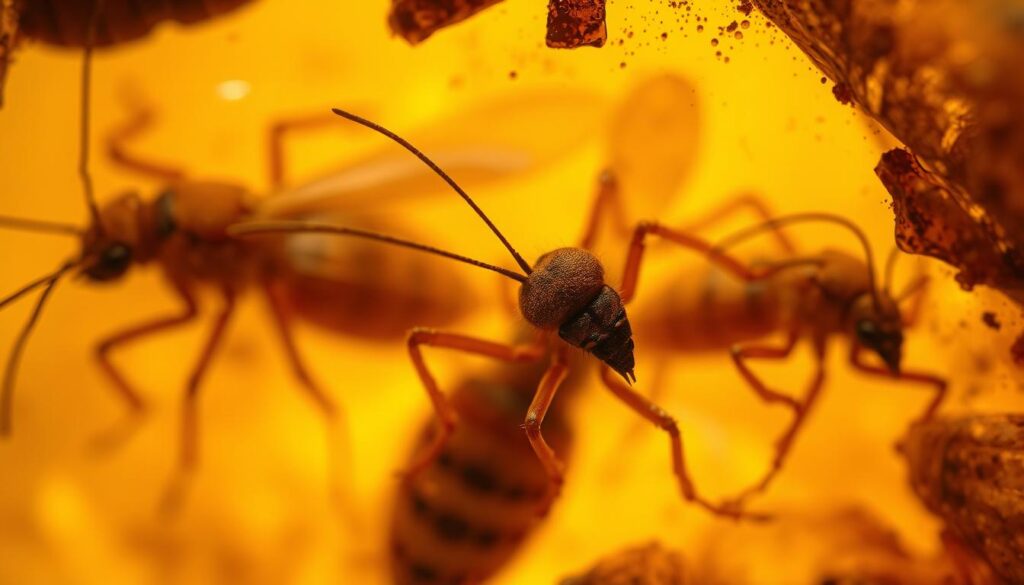
Studying insects in amber also helps us see how insects evolved. By looking at these fossils, researchers can figure out how different species changed over time. This helps us understand how they adapted to their surroundings.
The variety of insects in amber shows how diverse life was in the past. As scientists keep studying, we’ll probably find more extinct species. This will help us understand ancient biodiversity even better.
Dating and Analyzing Your Amber Specimen
Understanding your amber’s age and makeup is key to unlocking its secrets. Scientists use various methods to figure out where it came from and how it was formed.
Dating amber often involves Uranium-Lead or Potassium-Argon dating, based on mineral presence. Analyzing specimens means looking at the amber’s physical and chemical traits. This includes infrared and nuclear magnetic resonance spectroscopy.
For a deeper dive, collaboration with university research teams is a great idea. These teams have the latest tools and know-how in amber research fields like geology and chemistry.
Team up with these experts to learn more about your amber. You’ll discover its age, where it’s from, and any hidden treasures it might hold. This university research sheds light on your specimen’s history and importance.
Famous Insect in Amber Discoveries That Changed Science
Some of the most amazing scientific breakthroughs came from studying insects in amber. These ancient creatures, frozen for millions of years, have given us key insights into Earth’s history and life’s evolution.
In the 1990s, a well-preserved tick was found in amber from the Dominican Republic. This discovery helped scientists understand ticks’ evolution and their role in disease transmission. The tick, dating back to the Oligocene epoch, had a meal of blood, showing how ancient ticks fed.
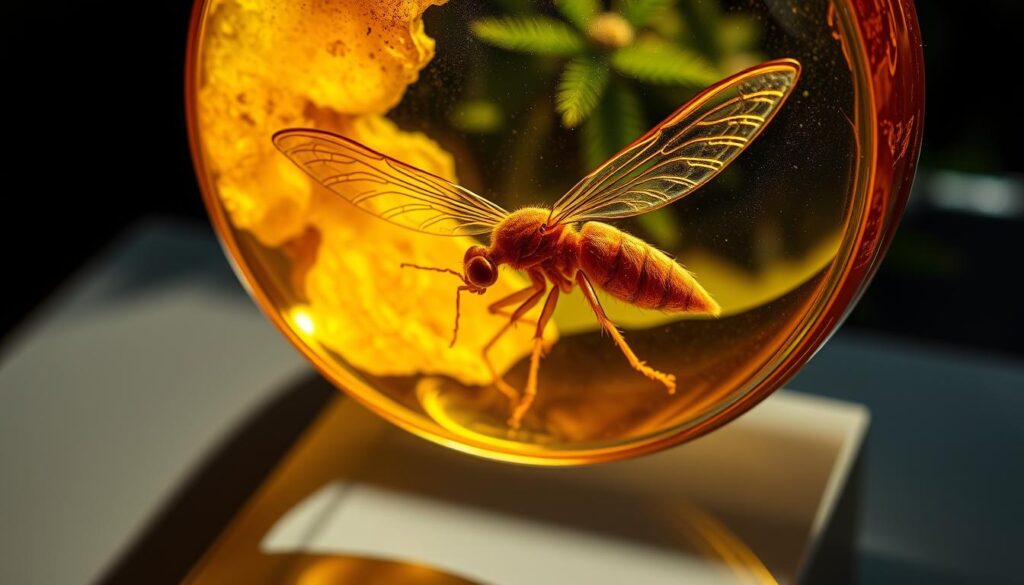
Another major find was the discovery of ancient bees in Eocene epoch amber. These bees, with their hair and details preserved, helped researchers grasp bee evolution and their role in pollination.
These discoveries have greatly impacted science, deepening our knowledge of the natural world and its evolution. The study of insects in amber remains a rich source of groundbreaking research, shedding light on Earth’s history and life’s evolution.
By studying these ancient insects, scientists learn more about Earth’s ecosystems and human environmental impact. The study of insects in amber is both captivating for scientists and the public, giving us a glimpse into the past.
From Jurassic Park to Reality: The Truth About Amber DNA
The idea of getting DNA from amber, made famous by Jurassic Park, has caught many people’s attention. The movie showed scientists finding dinosaur DNA from mosquitoes in amber. But, the real process of getting DNA from amber is much harder.
DNA extraction from amber is theoretically possible because amber can keep organic matter, like insects and plants, for millions of years. But, the process is full of problems, like DNA breaking down over time. Despite these issues, scientists have made big steps in getting and studying DNA from ancient amber samples.
Today’s research shows we can get DNA from fairly recent samples, but older DNA is often too damaged to recover. Jurassic Park aside, the oldest DNA found is much younger than the Jurassic period. Yet, studying amber and its contents is helping us learn about ancient worlds and how life evolved.
In summary, while getting dinosaur DNA from amber is science fiction for now, studying amber DNA has greatly helped us understand the past. As technology gets better, we might find more secrets in these ancient, golden treasures.
The Global Market for Amber with Insect Inclusions
Amber with insect inclusions is highly sought after worldwide. It’s prized by scientists and collectors for its beauty and historical value. This makes it a key player in the global market.
The amber market has seen a big increase because of these inclusions. They give us a peek into the past, showing us what ancient ecosystems were like. This has made amber with insect inclusions very valuable, affecting both science and the collector’s world.
The market for amber with insect inclusions spans the globe. Different countries play a part in its supply and demand. The value of amber depends on the type of insect, the condition of the amber, and where it comes from.
As demand keeps rising, it’s important to understand the amber market. This is true for both those who sell and those who buy. The value of amber with insect inclusions shows how important it is to have a market that’s both sustainable and well-informed.
Preserving Windows to the Past: The Future of Amber Research
The study of amber and its secrets is exciting for scientists and collectors. New technology will help us understand these ancient treasures better. This is a bright future for amber research.
It’s important to protect amber for the next generations. We must keep amber deposits and their surroundings safe. This way, we can learn more about life’s history on Earth.
Scientists worldwide are working together on amber research. They’re finding new ways to study amber and its contents. This makes the study of amber both thrilling and full of new discoveries.