







We often pick up everyday objects like a toothbrush, a ballpoint pen, or a scrap of paper without giving them a second thought. But have you ever wondered what these ordinary things might reveal when viewed under a microscope?
When we examine these objects more closely, we enter a fascinating world of microscopic images. These images show us details not visible to the naked eye. The science behind these tiny details is both captivating and educational.
Exploring the microscopic world can be a thrilling experience. It offers insights into the tiny structures that make up our everyday surroundings. By taking a closer look, we can gain a deeper appreciation for the complexity and beauty of the tiny things around us.
What is a Microscope?
A microscope is a tool that makes small things visible. It’s key in science, helping researchers and students see the tiny world. This science equipment is essential for studying the microscopic.
A microscope lets us see things too small for the naked eye. It shows details that are hidden, helping us understand the tiny universe.
Microscopes are vital in science. They help us study tiny life forms, cells, and structures. This is important in biology, medicine, and materials science. Knowing what a microscope is helps us see its big role in science.
In short, microscopes are essential for studying the tiny world. They’ve led to many discoveries and changes in science.
Types of Microscopes
The world of microscopy is full of variety. Different microscopes serve different needs and fields. They are key in biology, medicine, and materials science.
There are many types of microscopes. The most common are compound microscopes, stereo microscopes, and electron microscopes. Compound microscopes are great for schools and labs. They let us see tiny things up close.
Stereo microscopes give us a 3D view of things. They’re good for looking at the outside of tiny things. They’re used a lot in surgery and studying tiny details.
Electron Microscopes
Electron microscopes use electrons to make images. They can see much more than light microscopes. There are two kinds: TEM and SEM.
TEM shows what’s inside cells. SEM shows the outside of things. Both are very useful for studying tiny details.
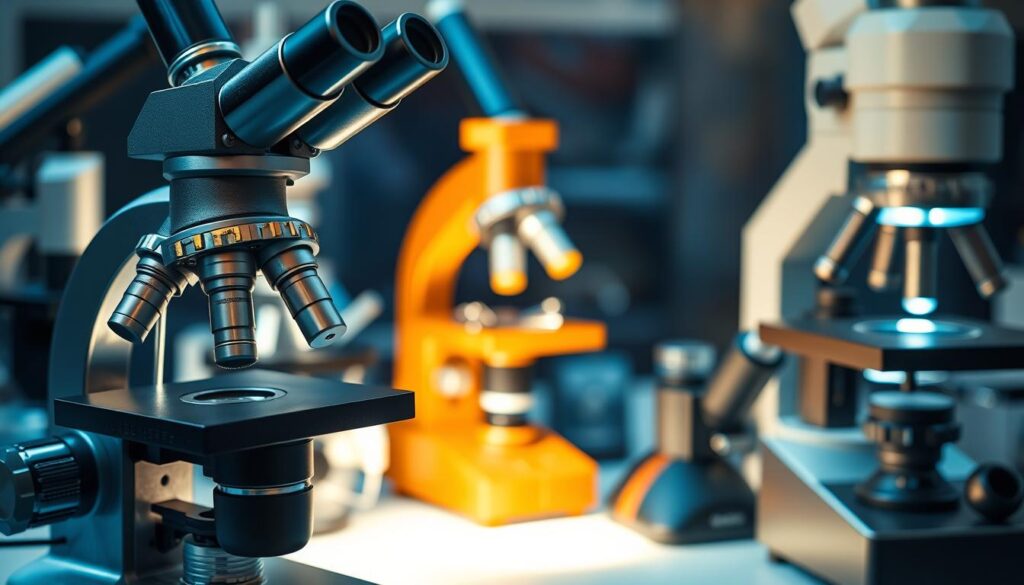
Choosing the right microscope is important. It depends on what you need to see. Knowing about different microscopes helps us pick the best one.
In summary, today’s microscopes let us see the tiny world in amazing detail. They’re used in education, research, and industry. There’s a microscope for every need.
How Microscopes Work
Microscopes make tiny things visible by using lenses. They help us see small details that are hard to see without them. This lets us explore the world in a new way.
Magnification and Optics are key to how microscopes work. The first step is the objective lens, which captures the first magnified image. Then, the eyepiece lens makes this image even bigger, showing us the tiny world up close.
“The microscope has revealed to us a new world, full of structures and organisms that were previously unknown.”
The quality of the lenses and how well they’re set up matter a lot. Good lenses and precise setup mean clearer, sharper images. Today’s microscopes use advanced optics to improve these images even more.
To sum up, microscopes use lenses to make small things visible. Knowing how microscopy works helps us understand the tiny details of our world.
The Importance of Microscopy in Science
Microscopy has been key in scientific research. It has led to major discoveries that changed how we see the world. This shows the importance of microscopy.
It helped us find cells and understand complex microorganisms. This has greatly advanced scientific knowledge. Seeing tiny structures has opened new paths for research.
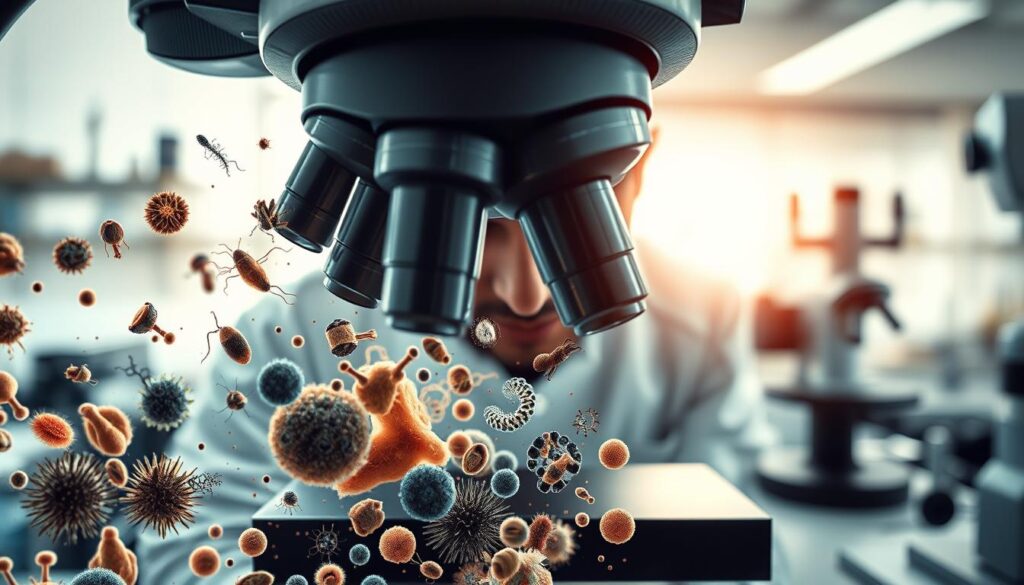
In today’s research, microscopy is very important. It lets scientists study tiny details closely. Tools like electron and fluorescence microscopy are key in biology, medicine, and materials science.
Microscopy has led to many breakthroughs. It has helped us understand diseases and create new materials. This has boosted technology and healthcare.
In summary, the importance of microscopy in science is clear. As research grows, microscopy will keep being vital. It will help us discover more and innovate.
Narrowing Down to Microbiology
Microbiology is all about studying tiny life forms. These tiny creatures, like bacteria and viruses, are too small to see without a microscope. That’s why microscopes are key in this field.
By using microscopes, scientists can study the shape, behavior, and how microorganisms interact in different places. Looking at microscopic images, they can spot different types of microorganisms. This helps them understand their roles in nature and how they might help in medicine and technology.
There are special ways to make microorganisms stand out under a microscope. For example, fluorescence microscopy lets scientists tell apart different bacteria by their unique traits.
Studying these tiny life forms is very important. It helps us fight diseases, grow better crops, and take care of our environment. Knowing about microorganisms is key to making new medicines, improving farming, and keeping our ecosystems healthy.
Choosing the Right Microscope
Choosing the right microscope is a big decision. There are many types, from simple to advanced. Knowing what you need is key.
Type of Microscope: Think about what you want to see. A stereo microscope is great for surface details. But, a biological microscope is better for cells and tiny organisms.
Magnification Power: Magnification matters too. Some microscopes can zoom in more than others. For example, compound microscopes can show more detail than stereo ones.
Intended Use: Consider how you’ll use the microscope. Is it for school, research, or quality checks? Each use might need a different microscope or special features.
Don’t forget about the quality of the optics and durability of the equipment. Good optics mean clear images. Durable equipment lasts longer.
In short, picking the right microscope is complex. It’s about knowing your options and what you need for your work.
Maintaining Your Microscope
Keeping your microscope in top shape is key. Regular care extends its life and keeps it working well. This ensures your microscope gives you accurate results.
Cleaning is a major part of microscope upkeep. Dust and dirt can harm the lenses and affect images. Start by dusting off loose particles with a soft brush or compressed air. Then, use a soft cloth to clean the lenses and other parts.
Storing your microscope right is also important. Keep it in a dry, clean spot, away from sunlight and extreme temperatures. Use a dust cover or case to protect it from dust.
Don’t forget to check and maintain the microscope’s mechanical parts. Lubricate moving parts and look for wear. This keeps your microscope running smoothly.
Always follow the manufacturer’s cleaning and maintenance advice. Different microscopes need different care. Check your user manual or contact the maker if you’re unsure.
By following these tips, your microscope will stay in great condition. This means you’ll get reliable and accurate results for many years.
Fun Experiments to Try at Home
Microscopy at home lets you see a new world with things you have at home. Many everyday objects show details we can’t see without a microscope.
Looking at salt and sugar under a microscope is really cool. Sprinkle a bit on a slide and see the tiny crystals. Salt crystals are usually cubic, while sugar crystals are more irregular.
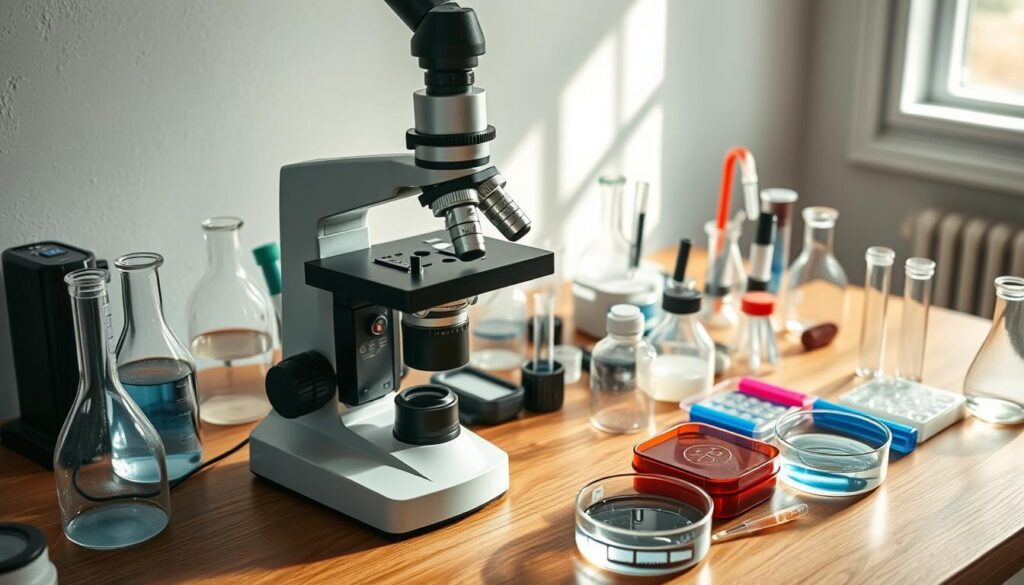
Another fun thing is to look at the tiny life in water. Put a drop of pond or tap water on a slide and see tiny creatures. This is a great way to learn about water’s tiny life.
Exploring fabrics and fibers is also interesting. Unravel a thread and see its texture under a microscope. Cotton looks like twisted ribbons, while synthetic fibers are smooth rods.
Trying different stains can make your microscope views even better. Use food coloring or ink to stain things. Trying different stains can help you see more and understand the tiny world better.
Educational Uses of Microscopes
Microscopes are key in education, giving students real hands-on science experience. They make learning science fun and easy to get. This is because they help students see and understand complex ideas better.
In schools, microscopes help teach biology, chemistry, and environmental science. Students get to see tiny things like cells and microorganisms up close. This helps them grasp scientific ideas more clearly.
Teaching with microscopes makes learning interactive and fun. It helps students think critically and be curious. It also connects theory with real-world application in science education.
Using microscopes in class makes learning more engaging and effective. It helps students understand science better. It also motivates them to become future scientists and researchers.
The Future of Microscopy
Microscopy technology is on the verge of a new era. This is thanks to new techniques and instruments. The future looks bright, with technology improving our ability to see and understand the tiny world.
Advances in Microscopy Techniques
Recently, microscopy has seen big changes. Super-resolution microscopy and live-cell imaging are among them. These have let scientists study life at a finer level than before.
Super-resolution microscopy lets us see things at the nanoscale. This is way beyond what old light microscopy could do. It’s opened up new areas for research in cell biology and neuroscience.
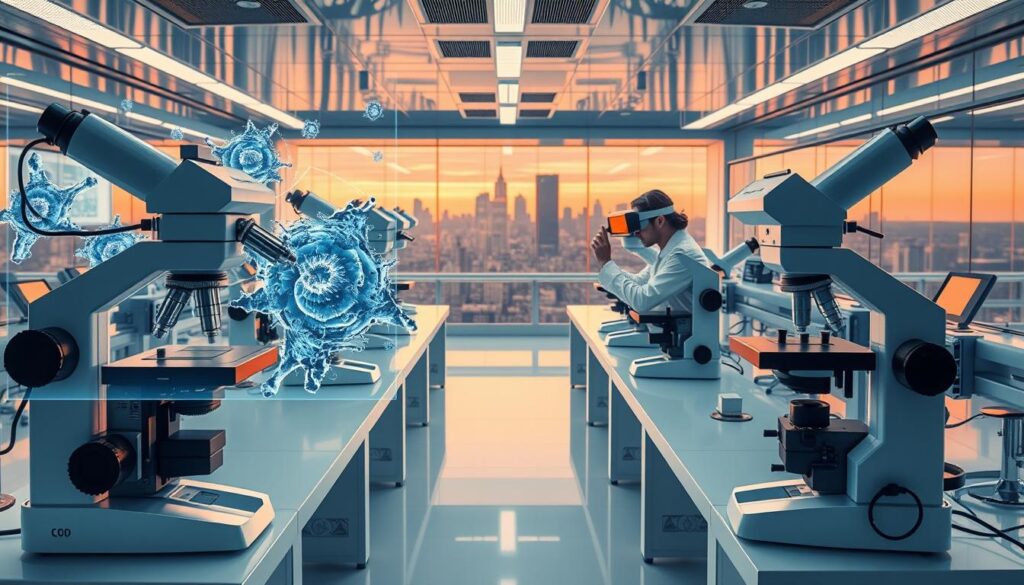
The future of microscopy will change science and education a lot. As technology gets better, researchers will explore new areas in biology and materials science.
“The development of new microscopy techniques will continue to revolutionize our understanding of the microscopic world, driving innovation and discovery.”
In schools, advanced microscopy will give students a chance to work with the latest tech. This will get them ready for the next generation of scientists and researchers.
Emerging Trends and Technologies
New trends in microscopy include using artificial intelligence and machine learning. These help with analyzing and understanding images. Also, microscopy technology is becoming easier and more accessible for everyone.
Looking ahead, microscopy will keep being key in our quest to understand the world. It’s an exciting time for science and discovery.
Resources for Microscopy Enthuisiasts
Microscopy fans have many online resources to explore. Online communities, like forums and social media groups, are great for sharing experiences and learning. They offer a place to ask questions and get advice from others.
The National Institute of Health’s (NIH) microscopy resources are a treasure trove. They have tutorials, videos, and research articles for all levels. Whether you’re just starting or are an expert, there’s something for everyone.
Online courses and webinars are also available. They cover topics like microscopy techniques and image analysis. These resources help deepen your understanding of the microscopic world.