







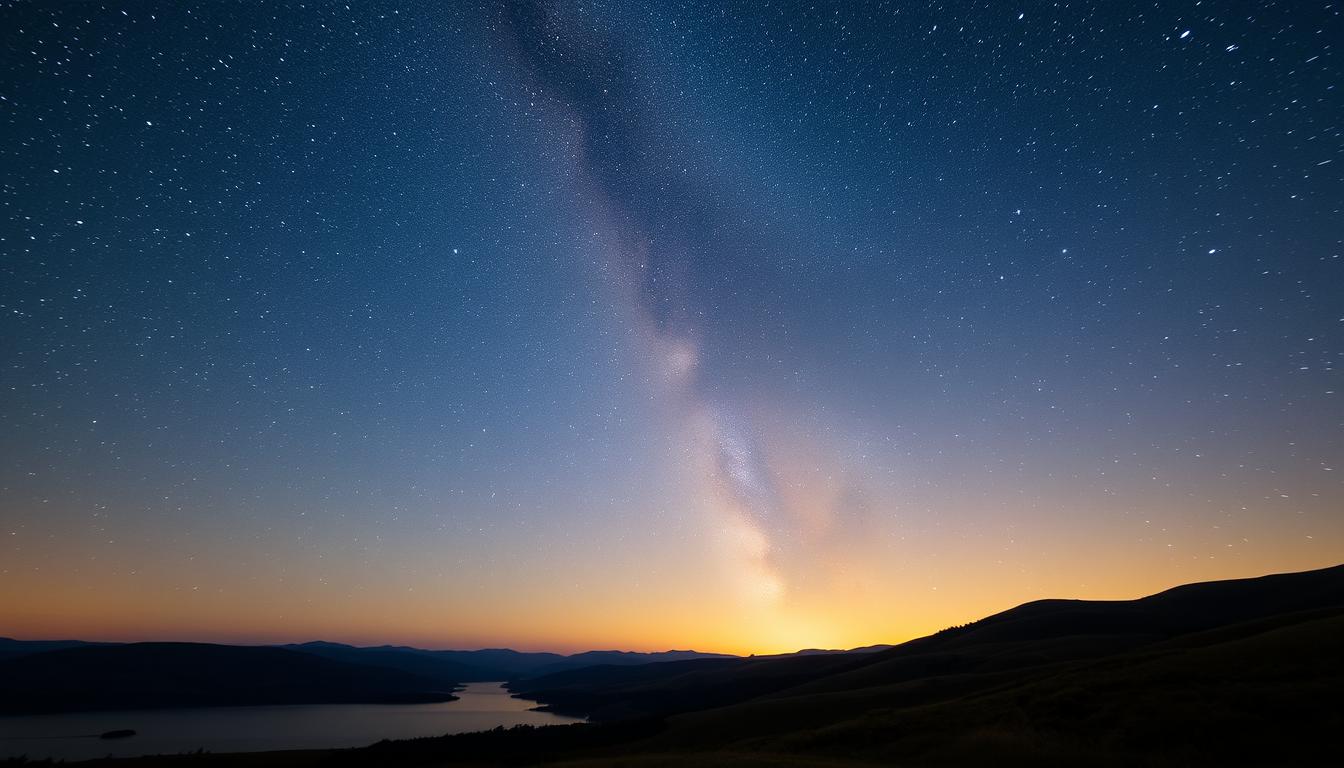
Gazing up at the night sky can be very moving. It gives us a peek into the vast universe beyond our planet.
Stargazing is more than just looking at stars. It’s a journey through time and space. Each constellation has its own story to tell.
Getting into astronomy can be very rewarding. It lets people connect with the universe’s wonders. By exploring the stars, we learn more about the cosmos and our place in it.
Understanding the Night Sky
Gazing up at the night sky can be a humbling experience, filled with mystery and wonder. The night sky is a dynamic tableau, with stars and planets shifting positions over time due to Earth’s rotation and orbit.
To truly understand the night sky, one must consider the Earth’s rotation and orbit. As our planet rotates, different parts of the sky become visible, creating the illusion of stars and constellations moving across the sky. The Earth’s orbit around the Sun also affects the visibility of certain celestial bodies throughout the year.
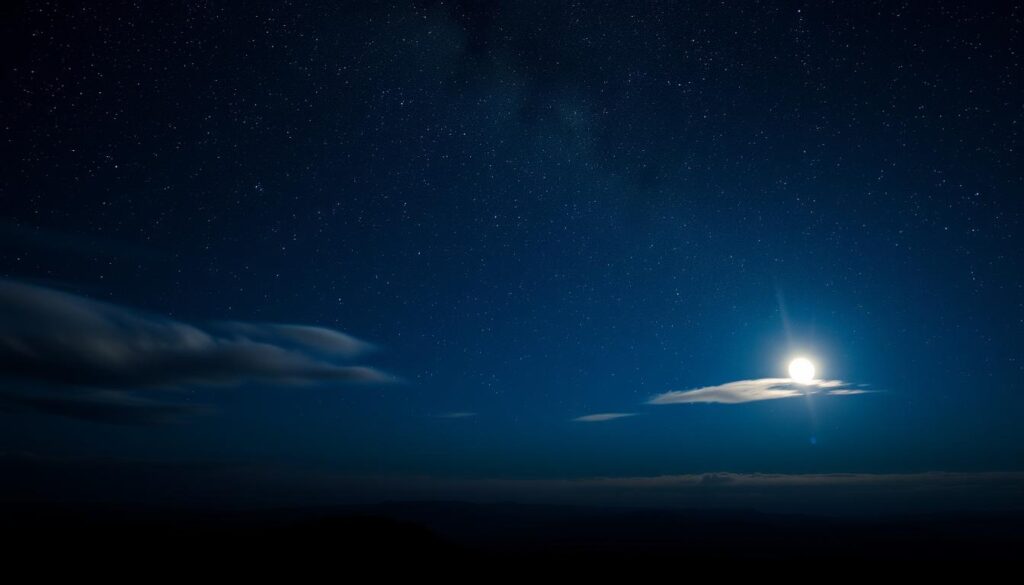
The phases of the moon also play a significant role in our perception of the night sky. From the new moon to the full moon, the changing phases can impact the visibility of stars and other celestial objects. As
“The universe is a pretty big place. If it’s just us, seems like an awful waste of space.” – Carl Sagan
In addition to the Earth’s movement and moon phases, understanding celestial bodies such as planets, asteroids, and comets can enrich our appreciation of the night sky. By recognizing these elements, we can better navigate and enjoy the ever-changing celestial landscape.
Essential Tools for Stargazing
Whether you’re an expert or just starting, the right tools are key for a great stargazing time. Tools have changed a lot, from old star maps to new apps. Now, it’s easier for everyone to explore the night sky.
Star maps show the night sky’s layout, with stars, planets, and more. They’ve been important for centuries. They help us understand the stars’ layout.
Digital vs. Traditional Star Maps
Digital technology has changed how we see the stars. Digital star maps, or apps, give real-time info on the sky. They let you find stars and planets easily. These apps also share cool facts about the sky.
Traditional star maps offer a different feel. They work anywhere, without needing batteries. They give a wider view of the sky. You can find simple maps or detailed atlases.
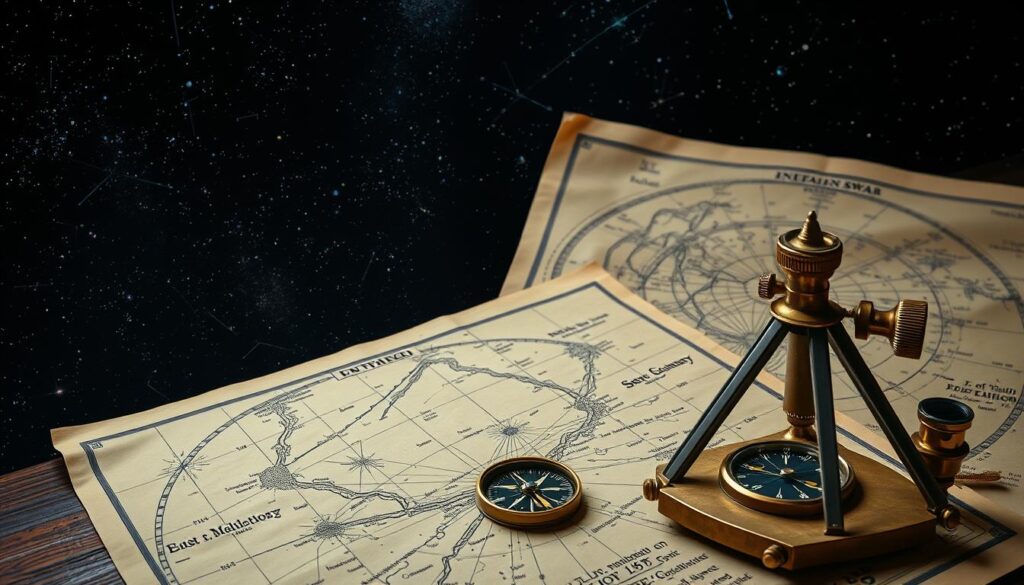
Choosing between digital and traditional maps depends on what you like. Some like the ease of digital tools. Others prefer the feel of traditional maps.
The best way to stargaze is to use both digital and traditional tools. This mix helps us learn and enjoy the sky more. It makes stargazing more rewarding.
The Best Locations for Stargazing
Dark skies are key for a great stargazing time. To enjoy the night sky fully, we must get away from city lights. These lights make it hard to see the stars.
Choosing a good spot for stargazing means looking at light pollution levels. Places with little artificial light offer a clearer view of the stars. National parks, remote countryside, and dark-sky preserves are top picks for stargazing.
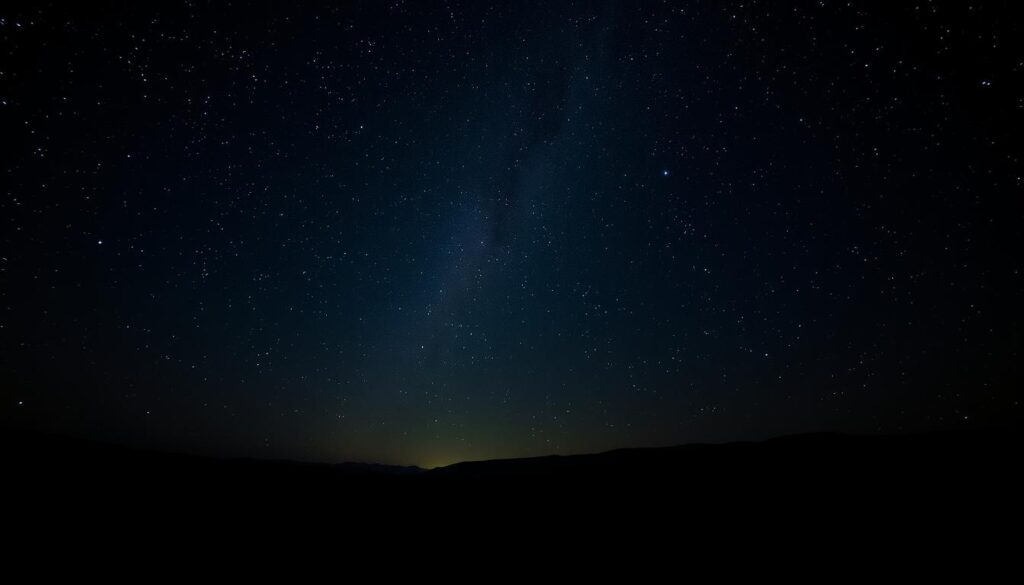
The International Dark-Sky Association says, “Dark-sky preserves are protected areas with amazing night sky views and little light pollution.” These spots are ideal for astronomy enthusiasts who want to see the night sky at its best.
“The best way to appreciate the beauty of the universe is to find a dark location, away from the city lights, and simply look up.”
Here are some tips for finding great stargazing spots:
1. Search for national parks or remote areas known for their dark skies.
2. Use online dark-sky maps to find places with low light pollution.
3. Plan your stargazing trip during the new moon for the darkest skies.
By following these tips and looking for stargazing locations with dark skies, you can improve your astronomy experience. Enjoy the beauty of the night sky.
Identifying Constellations
Looking up at the stars can make us appreciate the sky’s beauty and its stories. Constellations are like chapters in a cosmic book, each with its own pattern and tale.
The ancient Greeks named constellations after their myths. For example, Orion is named after a hunter. To find Orion, look for a star pattern that looks like a hunter’s belt and sword.
Start with constellations you can see all year, like the Big Dipper and Cassiopeia. These are easy to spot and help you navigate. The Big Dipper, for example, points to the North Star, Polaris, which is key for finding direction.
Mythology Behind the Stars
Knowing the myths behind constellations makes stargazing more interesting. For example, Andromeda is named after a princess who was saved from a sea monster. Learning these stories makes stargazing more fun and meaningful.
As you get to know the sky better, explore more constellations and myths. Astronomy apps and star charts are great tools to help you learn more about the stars.
The Life Cycle of Stars
Stars go through amazing changes, from protostars to white dwarfs. Stars evolve in fascinating ways, changing a lot during their lives. Their life cycle has many stages, each important for their growth.
A star starts as a protostar in a molecular cloud. It gets more massive until it starts nuclear fusion. Then, it becomes a main-sequence star.
On the main sequence, stars like our Sun turn hydrogen into helium. They release a lot of energy. This stage lasts the longest, depending on the star’s mass.
When stars run out of hydrogen, they become red giants. They grow big. For our Sun, this is followed by shedding its outer layers. This leaves a white dwarf, a hot, dense core that cools slowly over billions of years.
The life cycle of stars shows how dynamic the universe is. It helps us understand how celestial bodies are shaped. By studying a star’s life, astronomers learn more about astronomy in our cosmos.
The Science of Star Colors
The colors of stars are not just pretty; they tell us a lot about the stars. In astronomy, studying star colors is key to learning about celestial bodies.
The color of a star shows its surface temperature. Hot stars look blue, and cool ones look red. This is because of how atoms on the star’s surface interact with light. Stellar spectroscopy helps us understand these interactions.
Stellar spectroscopy analyzes the light stars give off. It lets astronomers know the star’s temperature and what it’s made of. This method is essential in astronomy for understanding stars.
Thanks to spectroscopy, scientists have made many discoveries. They can sort stars by their spectral types, which show their temperatures. This helps us learn more about the universe.
In summary, studying star colors with stellar spectroscopy is very important in astronomy. It gives us insights into stars’ temperatures and what they’re made of. As we learn more about spectroscopy, we’ll uncover more about the universe.
Fun Facts About Stars
Stars are full of surprises, from their incredible distances to their varied properties. One of the most fascinating aspects of stars is their life cycle. They are born, live, and die in a blaze of glory known as a supernova.
The study of astronomy has revealed many fun facts about stars. For example, the closest star to Earth, aside from the Sun, is Proxima Centauri. It is about 4.24 light-years away. A light-year is the distance light travels in one year, which is about 6 trillion miles.
Stellar phenomena like binary and multiple star systems are common in the universe. These systems have two or more stars that are gravitationally bound together. Studying these systems gives us valuable insights into the formation and evolution of stars.
Stars also come in different colors, which show their surface temperatures. Blue stars are hotter, while red stars are cooler. Our Sun is a yellow dwarf star, with a surface temperature of about 5,500 degrees Celsius.
The universe is vast, with billions of galaxies. Each galaxy has billions of stars. The diversity of stars and their properties makes studying astronomy a rich and exciting field. It is full of fun facts waiting to be discovered.
Safety Measures for Stargazing
To fully enjoy stargazing, it’s important to take safety precautions. Protecting yourself while looking at the stars makes the experience better.
Eye Protection is key when stargazing. Looking directly at sunlight or bright stars can harm your eyes. Always use solar filters or astronomical filters with telescopes or binoculars. Never look at the sun without proper eye protection.
Also, equipment safety is critical. Make sure your telescopes and binoculars are set up right to avoid accidents. Check your gear often for damage or wear.
At night, be mindful of your surroundings. Choose a safe spot, away from cliffs or water. Use a red light flashlight to keep your night vision sharp. This helps you see better in the dark without losing your adaptation to the dark.
By following these safety tips, you can have a safe and enjoyable stargazing time. Whether you’re an expert or new to astronomy, keeping safety first lets you enjoy the night sky without worry.
Getting Kids Involved in Stargazing
Introducing kids to stargazing can spark their curiosity and interest in space. It makes learning about astronomy fun and interactive. This way, parents and teachers can inspire the next generation of astronomers.
Start with simple activities like finding constellations and watching the moon’s phases. Using kid-friendly telescopes or binoculars makes it more exciting. You can also create a scavenger hunt to find different stars and planets in the sky.
Many astronomy groups and planetariums have educational programs for kids. These programs offer lots of information and activities. They help kids learn about space and stargazing. This makes stargazing a fun and educational hobby for them.