







Effective writing is key to getting your message across. Proper punctuation is essential for this. Without it, your writing can be hard to follow.
Clear punctuation makes your argument clear and keeps readers interested. Learning the rules of punctuation can greatly improve your writing skills.
Punctuation marks are the foundation of written communication. They help readers understand what you mean. This article will show you how to use periods, commas, and question marks correctly.
The Importance of Punctuation in Writing
In writing, punctuation is key to clear communication. It helps ensure the author’s message is understood without any confusion. Punctuation keeps your writing focused and clear.
Good punctuation keeps the text flowing smoothly. It guides the reader through your content. This prevents any confusion and makes your message clear.
Using proper grammar rules and punctuation boosts your writing skills. Your content becomes more engaging and informative. This makes your writing more effective at sharing your message.
Punctuation also helps avoid misunderstandings. It clarifies the text, making it easier to follow. It acts as a roadmap for readers through complex ideas.
In summary, punctuation is vital in writing. It’s essential for clear, effective communication. It makes your writing better and more understandable.
Understanding Periods: The Full Stop
Periods, or full stops, are key in writing. They help organize and structure content. They mark the end of a sentence or show that a word is shortened.
Periods in Abbreviations: Periods are needed for most abbreviations. For example, St. for Street, Dr. for Doctor, and Mr. for Mister all use periods.
Abbreviations and Periods
Knowing when to use periods with abbreviations is important. Abbreviations like etc. and e.g. do use periods. But, acronyms and initialisms like NASA and FBI do not.
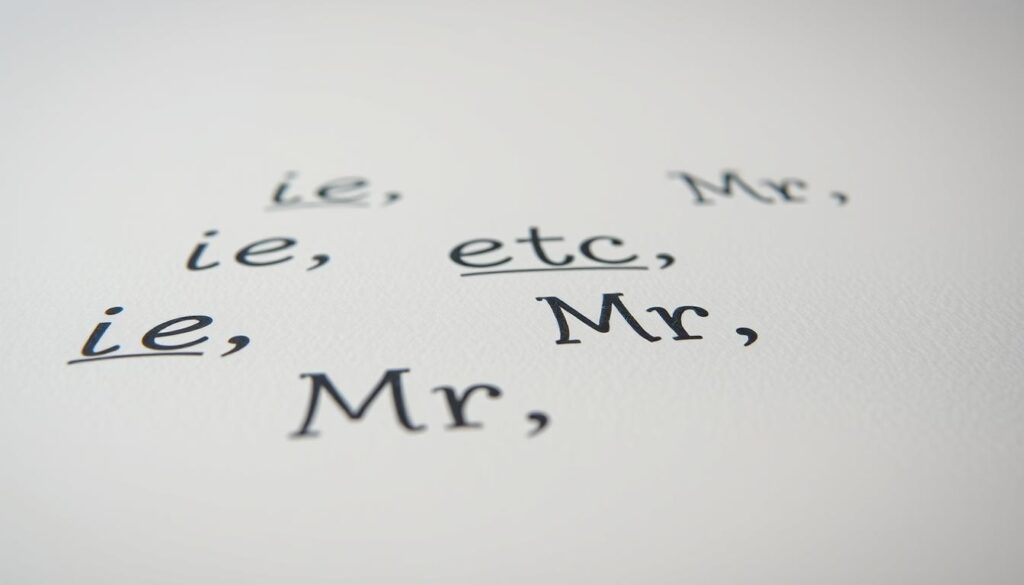
It’s key to know which abbreviations need periods and which don’t. For example, U.S. (United States) often has periods. But, it can also be written as US without periods, depending on the style guide.
By learning the rules for periods with abbreviations, writers can make their work clearer and more professional. Paying attention to punctuation is a sign of good writing.
The Power of Commas in Sentence Structure
Commas are key in making sentences clear and easy to read. They help writers share complex ideas simply. This makes our writing better.
Commas help separate items in lists and series. For example, when listing three or more items, commas make each item clear. Like this: “I had eggs, toast, and orange juice for breakfast.” Here, commas separate the breakfast items.
Commas in Lists and Series
Commas also mark non-restrictive clauses. These clauses add extra info not needed for the sentence’s meaning. For example: “The book, which was written by my favorite author, is on the bestseller list.” The extra info about the book is not essential.

Commas show direct address too. When we talk directly to someone, a comma is used. For example: “John, can you pass the salt?” The comma after “John” shows we’re talking to him.
Learning to use commas well can make our writing clearer and more engaging. It helps our readers enjoy what we write.
Question Marks: Indicating Inquiry
Question marks are key in showing we’re asking a question. They help set the tone of a sentence. They tell us the speaker is looking for information.
A sentence with a question mark asks for something. For example, “What is your name?” is a clear question. It ends with a question mark, showing we expect an answer.
Question marks also change the tone of a sentence. They can show curiosity, surprise, or even sarcasm. This depends on how they’re used.
For instance, “You’re going?” and “You’re going.” are different. The first asks about plans, while the second is a statement. This shows how punctuation rules are vital for clear meaning.
Knowing how to use question marks well helps writers connect with readers. It makes sure their messages are clear and understood.
Exclamation Points: Adding Emotion
In written communication, exclamation points show strong feelings or reactions. They add emphasis and emotion to sentences.
Exclamation points are great in creative writing like novels or poetry. They show feelings like excitement, anger, or surprise. For example, in dialogue, an exclamation point can show a raised voice or strong feelings: “I’m so excited to see you!” This usage helps to create a more dynamic and engaging reading experience.

But, in academic writing, exclamation points are usually avoided. Academic writing needs a formal and objective tone. Exclamation points might seem too enthusiastic or unprofessional. Instead, use careful word choices to show emphasis.
Knowing when to use exclamation points is key for good communication. By following punctuation rules, writers can make their message clear and intense. Whether in creative or formal writing, using exclamation points well can make your writing clearer and more impactful.
Semicolons: Bridging Related Ideas
The semicolon is a versatile punctuation mark. It links two independent clauses that are closely related. These clauses can stand alone as separate sentences.
For example, “I have a big test tomorrow; I’m studying all night to prepare.” Here, the semicolon connects two independent clauses. They are closely related in meaning. The semicolon shows a stronger break than a comma but weaker than a period.
Semicolons can also separate items in a list when those items have commas. For instance, “I’ve visited many cities in my lifetime; Paris, France, is my favorite; Rome, Italy, is a close second.” This makes the list clearer and avoids confusion.
Using semicolons effectively adds nuance and complexity to sentences. It makes the text more sophisticated and interesting to read.
Colons and Dashes: Creating Emphasis
Colons and dashes are key in punctuation. They help introduce lists, quotes, and add emphasis. Knowing how to use them makes writing clearer and more effective.
A colon introduces a list or quote that explains what came before. For example: “She had one goal: to win the championship.” Here, the colon clearly states her goal.
Colons also introduce quotes that add more insight. A famous linguist once said,
“The use of colons and dashes can dramatically change the interpretation of a sentence, adding nuance and complexity to the narrative.”
This shows how punctuation shapes meaning.
Dashes for Emphasis or Clarification
Dashes add emphasis or clarify sentences. They can highlight a point or show a pause in thought. For instance: “The manager – a very strict person – was not happy with the results.” Dashes here add more about the manager.
Dashes also create drama or highlight important details. As “The Future of Punctuation” points out, “Dashes add a touch of informality and flair to writing.”
In summary, mastering colons and dashes is key for good writing. They help add emphasis, introduce lists or quotes, and make writing clear.
Quotation Marks: Signifying Dialogue and Titles
Quotation marks are key in punctuation. They show dialogue and titles. They help readers know when it’s direct speech or a title.
When writing dialogue, it’s important to put quotation marks right. For example: “I have a dream,” she said, her voice filled with conviction. This shows the words are spoken by someone.
Quotation marks also mark titles of smaller works. Like poems, short stories, or articles. For example, “The Gift of the Magi,” is a short story title, set apart from a book title.
Quotation Marks for Titles
Quotation marks are standard for titles in many styles. They help tell apart a book or movie title from a chapter or article. For example, “The Impact of Climate Change,” is an article title, in quotation marks.
“The way to get started is to quit talking and begin doing.”
In summary, quotation marks are useful for dialogue and titles. They make writing clearer and easier to read. This helps readers understand the context and importance of what’s being quoted or titled.
The Role of Punctuation in Different Writing Styles
Punctuation is key in many writing styles. It changes based on the content’s purpose and context. In academic writing, it helps share complex ideas clearly. Commas, semicolons, and colons make the text easier to follow.
Punctuation in Creative Writing
Creative writing uses punctuation in a more flexible way. Authors use it to set a tone or create a certain feel. For example, dashes or ellipses can add drama or a pause.
Knowing how punctuation works in different writing styles is vital. It helps writers share their message clearly. This way, they can engage their audience and meet their goals.