







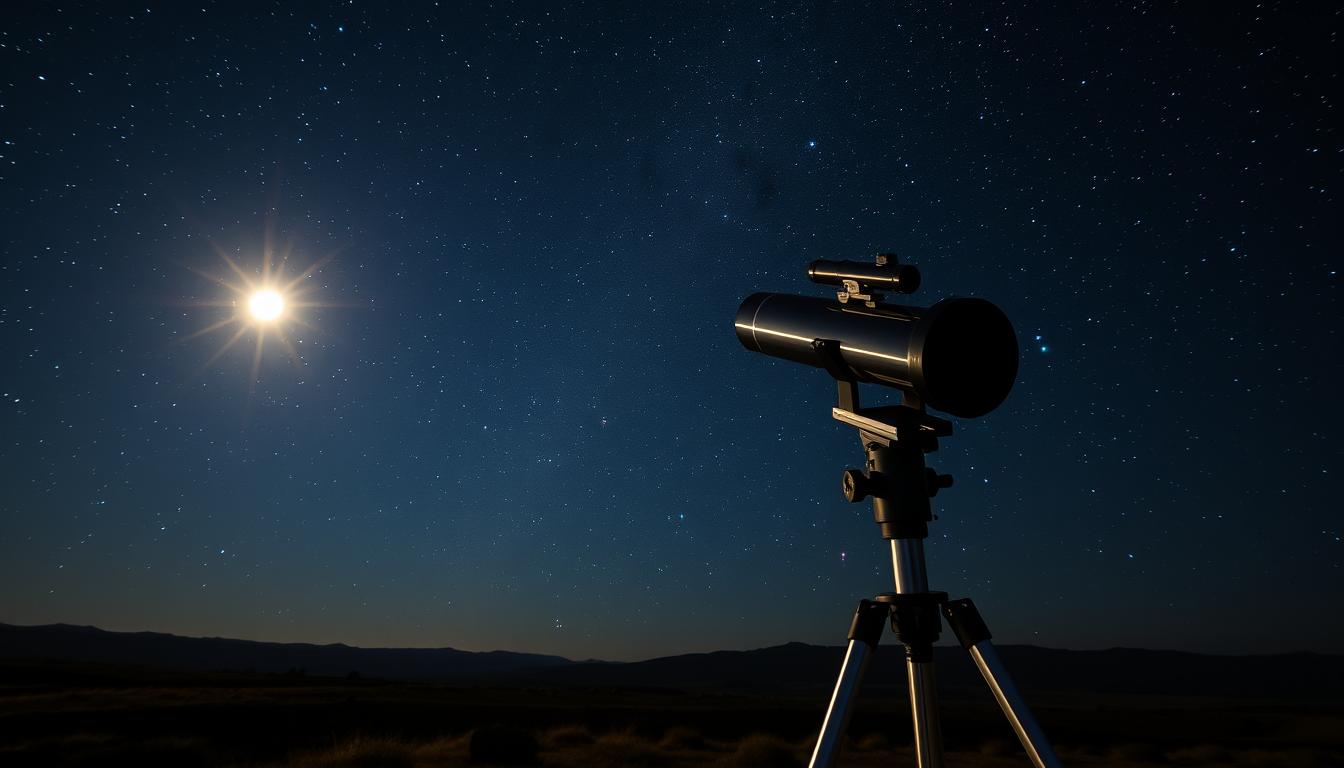
Gazing up at the night sky has always fascinated humans. The stars, planets, and galaxies call to us to explore the universe. Astronomy lets us peek into this vastness, helping us grasp the cosmos.
Starting with stargazing can seem tough. But, with the right help, it becomes a fun hobby. This guide will teach you the basics of using a telescope to see the night sky.
By the end of this guide, you’ll be ready to explore the universe. You’ll see the Moon’s craters and Saturn’s rings.
Understanding the Basics of Telescopes
A telescope is an optical tool that helps us see the universe better. It’s all about how well it can show us two close things clearly.
Resolution is key because it shows how detailed the view is. A better resolution means a sharper image. This is super important in astronomy, where seeing small details helps us learn more.
The magnification power of a telescope is also important. It makes things look bigger, but it’s the resolution that makes them look clear. Finding the right balance between these two is important for a good telescope.
Optics are very important for a telescope to work well. The quality of the lenses or mirrors affects how well it focuses light and shows clear images. As
“The telescope is an essential tool for astronomers, allowing us to study the universe in unprecedented detail.”
Knowing the basics of telescopes, like their optics and resolution, is key to understanding their role in astronomy. It helps users see what their telescopes can do and what they can’t.
Choosing the Right Telescope for You
Understanding the different types of telescopes is key to unlocking the secrets of the universe. The main decision is between reflector and refractor telescopes. Each has its own unique characteristics.
Reflector Telescopes use a mirror to gather and focus light. They are known for their ability to provide bright and clear images of deep-space objects like galaxies and nebulae. Reflectors are often preferred by astronomers for their value for money and the ability to observe faint objects.
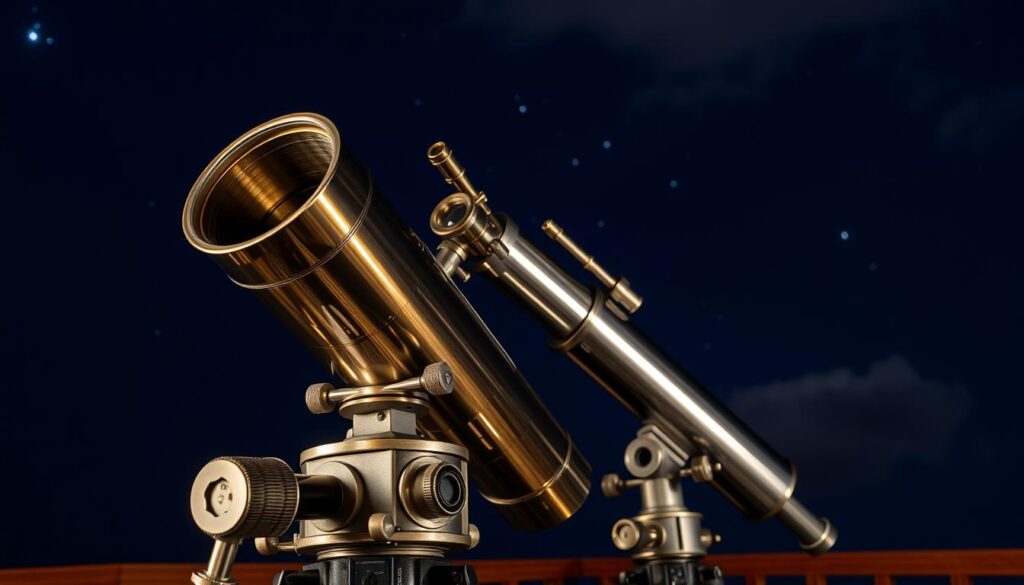
Refractor Telescopes, on the other hand, use a lens to focus light. They are renowned for their sharp, high-contrast images, making them ideal for observing planets and double stars. Refractors are generally easier to maintain and use than reflectors, as they require less adjustment over time.
Reflector vs. Refractor Telescopes
When deciding between a reflector and a refractor telescope, several factors come into play. Consider your budget, the type of objects you want to observe, and your level of expertise. Reflectors tend to be more cost-effective for larger apertures, while refractors offer superior image quality for planetary observation.
The choice between reflector and refractor telescopes ultimately depends on your personal preferences and astronomical goals. By understanding the strengths and weaknesses of each telescope type, you can make an informed decision that enhances your stargazing experience.
Whether you’re a seasoned astronomer or just starting out, choosing the right telescope can significantly impact your ability to enjoy the night sky. By considering the different telescope types and their applications, you can find the perfect tool to explore the universe.
Setting Up Your Telescope
Setting up your telescope is the first step to enjoying the stars. It involves several important steps. These include assembling the telescope, making initial adjustments, and ensuring collimation.
Assembling your telescope correctly is key. Follow the manufacturer’s instructions carefully. Make sure all parts are securely attached. A stable tripod is also essential for clear views.
Initial adjustments are needed to align the telescope’s parts. You might need to adjust the focuser, level the mount, and align the finderscope. These steps help you get a clear image.
Collimation is critical for your telescope’s performance. It aligns the optical elements for seamless work. For reflector telescopes, aligning the primary and secondary mirrors is important. Proper collimation ensures high-quality images.
Regularly check and adjust your telescope’s setup. Changes in temperature can affect alignment. Regular checks keep your telescope in top condition.
By following these steps, you’ll enjoy stargazing. Remember, patience and attention to detail are key for the best views.
Mastering Telescope Operation
Learning how to use your telescope is key to enjoying stargazing. Understanding the importance of eyepieces and accessories is vital. They help improve your viewing experience.
Eyepieces play a big role in the quality of what you see. They come in different types, affecting magnification and field of view. The right eyepiece depends on what you want to see. For example, a wide field of view is great for big objects like nebulae.
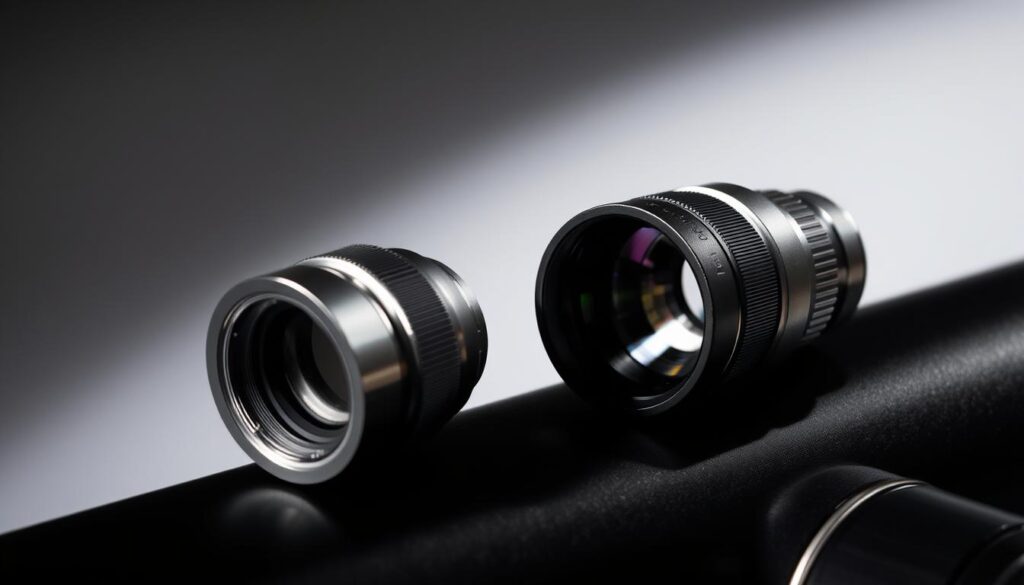
Accessories like filters and Barlow lenses also boost your telescope’s power. Filters can make certain features clearer by reducing glare. Barlow lenses increase magnification without losing image quality. Knowing how to use these can greatly improve your telescope skills.
Setting up and using your telescope regularly is also important. The more you practice, the better you’ll get. This lets you focus on the details of what you’re observing.
Using the right eyepieces and accessories, along with practice, makes stargazing better. Whether you’re new or experienced, mastering your telescope opens up the sky for you.
Exploring the Night Sky
With your telescope, you’re not just looking at the stars; you’re embarking on a journey through the cosmos. The night sky is a vast and fascinating place, full of celestial wonders waiting to be discovered.
One of the most rewarding experiences in astronomy is observing the Moon. Its surface, with craters and mountains, offers a detailed view that can be both educational and mesmerizing. To enhance your viewing experience, try observing the Moon at different phases. During the crescent or gibbous phases, the shadows on its surface are more pronounced, revealing intriguing details.
Another thrilling target for your telescope is the planets. Each planet in our solar system offers a unique viewing experience. For instance, Jupiter’s cloud bands and moons are a treat to observe, while Saturn’s rings are a marvel of celestial engineering. When observing planets, pay attention to their position in the sky and the atmospheric conditions. Clear skies and optimal telescope settings can significantly enhance your observations.
To make the most of your telescope, consider keeping a log of your observations. Note the date, time, and conditions of your viewing sessions, as well as any notable observations. This practice not only helps you track your progress but also deepens your understanding of the celestial bodies you’re observing.
Exploring the night sky is a journey that combines science, curiosity, and wonder. With your telescope as your guide, you’re ready to uncover the secrets of the universe, one celestial body at a time.
Maintaining Your Telescope
Keeping your telescope in good shape can make stargazing even better. Regular care helps your telescope work its best. This means you get clear, sharp views of the stars.
Why Maintenance Matters
Telescope upkeep is more than just cleaning. It’s about keeping it in top shape for years. Dust, dirt, and misalignment can ruin your views.
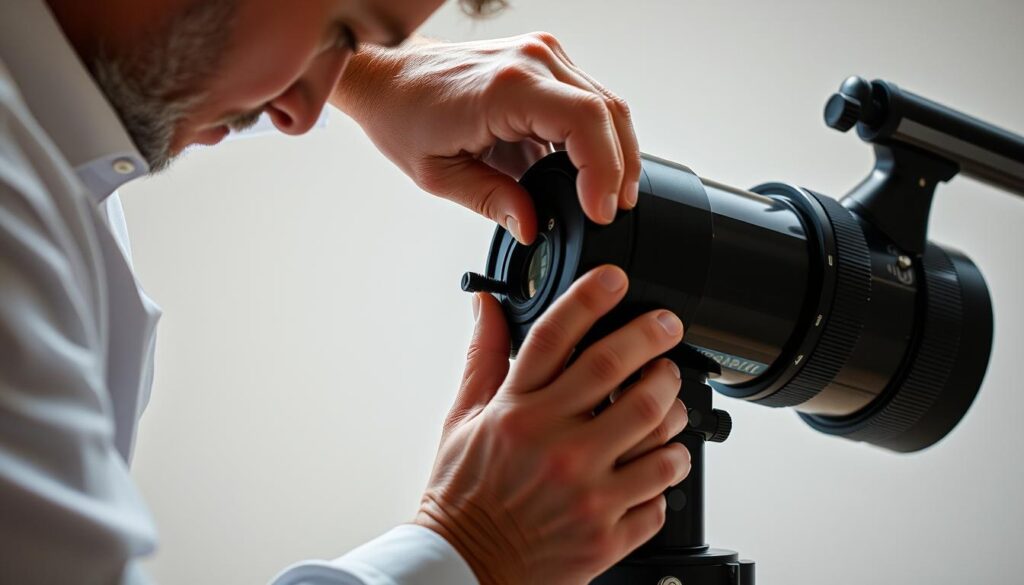
Cleaning is key. Use a soft, dry cloth for the outside. For deeper cleaning, try special solutions and microfiber cloths. Don’t touch the optics with your hands, as skin oils can harm the coatings.
“A clean telescope is a happy telescope,” many astronomers agree. Cleaning keeps your telescope looking good and working well.
Collimating Your Telescope
Collimation aligns your telescope’s parts. It’s vital for sharp images. You adjust mirrors or lenses to get them just right.
“Collimation is key to getting the most out of your telescope. It’s a skill that takes practice, but the payoff is well worth the effort.”
By following these tips, your telescope will stay in great shape. A well-cared-for telescope opens up the universe to you.
Enhance Your Observations
Using filters and accessories can make your telescope experience better. These tools help improve the quality of your views, letting you understand the night sky more deeply.
Telescope filters are a key way to enhance your views. They reduce glare, improve contrast, and reveal details you might miss. For example, a moon filter makes the moon’s surface easier to see.
Other accessories can also boost your experience. Barlow lenses increase magnification, and eyepiece filters make some objects more visible. It’s important to pick accessories that fit your telescope and what you want to see.
When picking filters and accessories, think about what you want to observe. Different filters are needed for planets versus deep space. Knowing what you want to see helps you choose the right tools.
Adding the right filters and accessories to your telescope can greatly enhance your observational abilities. This not only makes your views better but also makes stargazing more enjoyable.
Special Observing Targets
Galaxies and nebulae are amazing sights through a telescope. They give us a peek into the universe. To see them, you need patience, the right tools, and some knowledge.
Looking at galaxies means seeing huge systems of stars and gas. The Andromeda Galaxy is a favorite among beginners. It’s close to us and can be seen with a good telescope.
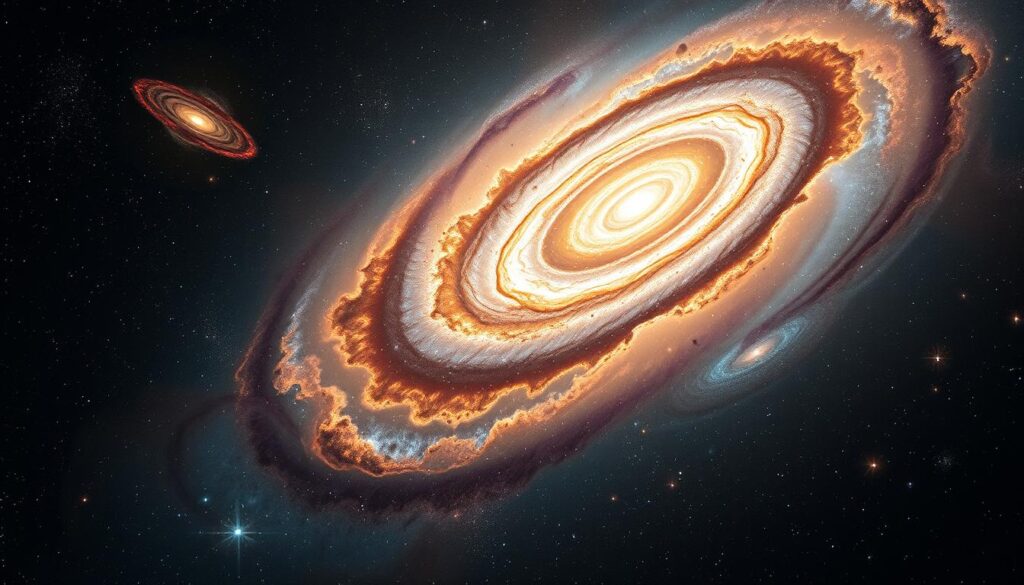
Nebulae are huge clouds of gas and dust. They are where new stars are born. The Orion Nebula is famous and easy to spot. It looks incredible through a telescope.
Astronomer
“The study of galaxies and nebulae is key to understanding the universe.”
Seeing these objects is not just fun. It also helps us learn more about space.
To better see galaxies and nebulae, use a big telescope and a steady mount. Star charts or software can help find them. Beginners might want to start with the Andromeda Galaxy or Orion Nebula.
Sharing the Experience
The world of astronomy is richer when shared with a community. Joining astronomy communities offers many benefits. You get access to a wealth of knowledge, resources, and like-minded individuals who share your passion for stargazing.
Connecting with others who love astronomy can open new doors. You can learn new techniques and stay updated on the latest discoveries. Many communities organize events, viewing parties, and workshops to enhance your telescope experience.
Astronomy Communities and Resources
There are many types of astronomy communities and resources out there. Online forums, social media groups, and specialized websites are great places to start. You can also find local astronomy clubs in your area, which host meetings, star parties, and more.
Online Resources
Using online resources can also improve your astronomy experience. Websites focused on astronomy news, educational content, and sky maps offer valuable information and tools. Many of these resources are free or offer premium content for a subscription.
Some popular online resources include astronomy apps. These apps help you identify celestial objects, forecast astronomical events, and plan your stargazing sessions. By using these tools and connecting with the astronomy community, you can deepen your understanding and appreciation of the night sky.
Learning from the Experts
Getting advice from expert astronomers can really help you get the most out of your telescope. They’ve spent years learning and can share expert tips to make your stargazing better.
One key piece of astronomy advice is to know your telescope well. Learn about its features and settings to get the best views.
As a famous astronomer said, “The best observations come from knowledge, patience, and practice.” This shows how important it is to keep learning and practicing.
“The best observations come from a combination of knowledge, patience, and practice.”
By following expert tips and staying dedicated to astronomy, you can improve your skills. This will make your stargazing even more enjoyable.
Future of Telescopes
The world of astronomy is on the cusp of a revolution. This is thanks to
telescope technology
advances that are continually improving our view of the universe. As we look to the future, it’s clear that telescopes will play a key role in our understanding of the cosmos.
Advances in telescope technology are allowing astronomers to study the universe in greater detail. New materials and technologies are making telescopes more powerful, efficient, and accessible.
The future of telescopes is exciting, with next-generation ground-based telescopes and advanced space-based observatories on the horizon. As these advances continue, we can expect to gain new insights into the universe. This includes understanding the formation of stars and galaxies and the search for life beyond our planet.