







For centuries, humans have been fascinated by the night sky. A star chart is key in astronomy. It acts as a map to find different objects in space.
Star maps use a grid to show the night sky. They help us find constellations, nebulae, galaxies, and planets. This skill is vital for celestial navigation. It helps both travelers and astronomers find their way.
Star charts are more than just for navigation. They open up the universe to us. Learning to read them lets us appreciate the night sky’s beauty and mysteries.
What is a Star Map?
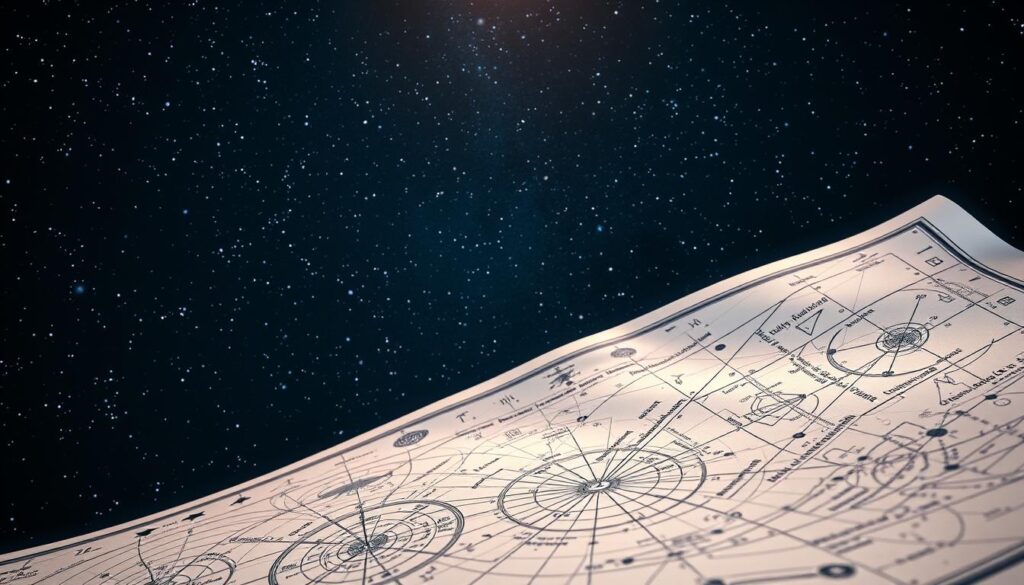
A star map is more than a chart; it’s a window into the universe. It shows the positions of stars, constellations, and other celestial bodies. For centuries, star maps have been key for celestial navigation and understanding the night sky.
Making a star map involves complex data. It charts the locations of countless stars and constellations. This requires precise measurements and a deep understanding of astronomy. The result is a graphical representation that helps users identify celestial objects and their patterns.
Star maps come in various forms, catering to different needs and preferences. Some are designed for specific times of the year or for particular regions of the sky. Others are more all-encompassing, covering the entire celestial landscape. Whether for a professional astronomer or a casual stargazer, there’s a star map available for every purpose.
The significance of star maps goes beyond their practical use. They also hold cultural and historical value, showing our ancestors’ understanding and reverence for the night sky. In the context of celestial navigation, star maps have been vital for travelers and explorers throughout history.
In modern times, star maps continue to evolve, incorporating new technologies and data. Digital star maps can be accessed on smartphones and computers, making it easier than ever to explore the night sky. For anyone interested in astronomy, a star map is an invaluable resource, providing insights into the universe and our place within it.
How to Use a Star Map
A star map is more than just a guide; it’s your key to understanding the celestial world. To start stargazing, you need to find the constellations and spot the stars in them.
The North Star, also known as Polaris, is key for celestial navigation. It stays fixed in the sky while other stars seem to move around it. To use a star map well, first learn the constellations and their shapes.
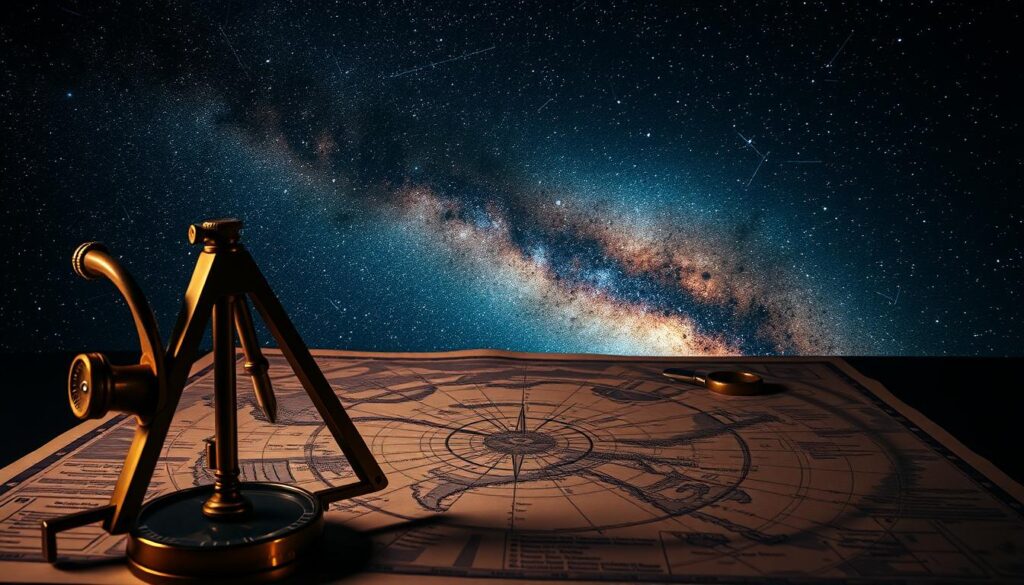
Start by holding the star map up and aligning it with the direction you’re facing. Hold it overhead, with the direction you’re facing at the bottom. This helps you see the constellations in the sky.
Then, find the North Star. It’s in the Ursa Minor constellation. Look for it by drawing a line through the two stars at the end of the ‘dipper’ in Ursa Major. Once you find Polaris, you can use it to find other constellations and stars.
Using a star map often will make you better at navigating the night sky. It takes patience and practice, but with time, you’ll get good at stargazing and understanding the sky.
Key Constellations to Know
There are 88 constellations officially recognized. Some stand out for their importance in astronomy and myths. These constellations help us navigate the night sky and understand the universe.
Orion is a famous constellation named after a Greek hunter. It’s easy to spot because of its three-starred “belt.” Orion is a key marker in the winter sky for those in the Northern Hemisphere. Its visibility and meteor showers make it a hit with astronomers and stargazers.
Cassiopeia, named after a Greek queen, is another important constellation. It looks like a “W” or “M” and is always visible in the Northern Hemisphere. Cassiopeia is not just famous for its myth but also for helping find other stars and constellations.
Ursa Major, or “Greater She-Bear,” is key for navigation. The two stars at the end of its “dipper” are called “pointer stars.” They guide to the North Star (Polaris), a vital aid for navigation. Knowing these constellations is vital for using a star map to navigate the night sky.
These constellations are just a few of the many patterns in the sky. Learning about these and other constellations can deepen your love for astronomy. It also helps you use a star map better.
The Science Behind Star Maps
Star maps are more than just pictures. They come from complex calculations in astronomy. These maps show the locations and paths of stars, planets, and constellations.
Astronomical calculations are key. Astronomers use special formulas to figure out where these objects are at any time. They consider things like eclipses and when planets line up. Getting these calculations right is essential for a star map to be trustworthy.
The Kepler space telescope has helped us learn more about the sky. It was launched in 2009 and has found thousands of planets outside our solar system. It has also given us a lot of information about stars, making star maps more accurate.
Celestial navigation is also tied to star maps. It helps people find their way by using the stars and constellations. Sailors and travelers have used this method for centuries. It’s just as useful today.
The science behind star maps shows our endless curiosity about the universe. As we learn more, star maps will get even better. They will give us new views of the night sky and our place in it.
Tools for Star Mapping
The art of star mapping has changed a lot, from old ways to new digital tools. In the past, astronomers used manual observations and complex math to navigate the sky. Now, many tools help both fans and experts to understand and explore the stars.
A planisphere is a circular map that shows the stars at a specific time and place. It’s a simple tool used for centuries. By setting the planisphere to the current date and time, you can find constellations and stars. It’s great for beginners because it’s easy to use.
In today’s world, smartphone apps are very popular for mapping the stars. Apps like Sky Map and Star Walk use your phone’s GPS and compass to show the stars in real-time. They also have cool features like augmented reality, letting you see star names and constellations on your screen. This makes learning about astronomy fun and easy.
If you like to get hands-on, telescopes and binoculars are key. They don’t replace digital apps, but they let you see stars up close. Telescopes, with computerized mounts, make it easy to find stars and constellations.
There are many tools for star mapping, from simple planispheres to advanced digital apps and telescopes. Whether you’re an expert or just starting, there’s a tool for you.
Tips for Beginners
Stargazing is fun for everyone, and it’s easy to start. First, learn how to read a star map. A star map is a guide to the night sky. It helps you find constellations and explore the sky.
Start by learning the most common constellations. Look for the Big Dipper, Orion, and Cassiopeia. Knowing these will help you use your star map better.
When using a star map, hold it right. Match the map with the date and time you’re looking at the sky. Practice makes perfect, so don’t worry if it takes a few tries.
Beginners should use simple star maps. There are apps and online tools that offer interactive maps. These are great for learning the sky. As you get better, you can use more detailed maps and dive deeper into astronomy.
Remember, stargazing is a patient person’s hobby. Take your time to enjoy the sky. With these tips, you’ll soon be good at using a star map and loving the night sky.
Cultural Significance of Star Maps
Star maps have been key in shaping cultures, spirituality, and navigation. They guided sailors and travelers. They also played a big role in myths and spiritual stories of many cultures.
In ancient times, star maps helped predict seasons, farming, and big events. The ancient Greeks used them to sail and learn about constellations’ myths. Many indigenous cultures used them for farming and spiritual rituals.
The cultural significance of star maps goes beyond practical uses. They inspired art, literature, and music. The night sky, shown in star maps, has always fascinated us, shaping our culture.
Studying star maps also led to sharing knowledge between cultures. This sharing has deepened our understanding of the stars and their importance worldwide.
In summary, star maps are more than navigation tools. They are cultural treasures that show our deep connection to the universe.
Advanced Star Mapping Techniques
Advanced star mapping uses advanced techniques and tools. For those who already know about star mapping, there are many ways to improve. These methods make observations more accurate and detailed.
Using specialized software is a key advanced technique. Programs like Stellarium and SkySafari create detailed star maps. They can also show the night sky for any place and time. These tools help plan observations and find celestial objects.
Creating custom star maps is another advanced technique. By making maps for specific needs, astronomers can look at certain sky areas or follow celestial events. This can be done with software or manual skills.
Also, advanced star mapping can add additional data to traditional maps. This includes asteroid paths, comet tracks, or variable star info. This layered approach gives a deeper view of the sky.
Using these advanced techniques makes star mapping more rewarding. It offers deeper insights into astronomy and the night sky. Whether for professionals or hobbyists, these methods lead to new discoveries.
The Future of Star Mapping
The field of star mapping is on the verge of a big change. This is thanks to new technology and our growing knowledge of the universe. Artificial intelligence and machine learning will be key in this change.
Star maps will get much better, helping us navigate space more accurately. They will also help us understand the stars and planets better. AI and ML will help astronomers sort through lots of data, find patterns, and predict future events.
As we look ahead, humans and machines will work together more. This will lead to new discoveries and a deeper understanding of the universe. Star maps will keep being important, helping us explore space and uncover its secrets.